Saona Island Catamaran Tour: What Changes On The Water
Most Saona Island trips involve both boat types: speedboat out, catamaran back. Choosing the catamaran-forward tour changes the pace, the comfort and the whole rhythm of the day, and the differences are bigger than most booking pages admit.
Short answer
A Saona Island catamaran tour is a full-day trip, usually 6 to 12 hours door to door, that crosses from Bayahibe under sail-power or motor at a relaxed pace, typically 1 to 2 hours each way. Group catamaran day trips run from US$63 to US$116 per person, lunch and drinks are commonly included, and the format suits travelers who value comfort over speed.
Every boat to Saona Island leaves from the Bayahibe pier area on the Dominican Republic's southeast coast, and almost every one of those boats is either a speedboat or a catamaran. Many tours use both. The standard mixed itinerary runs speedboat out and catamaran back, so a lot of visitors experience the catamaran only as the sleepy return leg after the beaches. A catamaran-forward tour flips that: the slow boat becomes the point of the day rather than the comedown.
That choice matters more than it sounds. The crossing from Bayahibe to Saona usually takes 20 to 60 minutes by speedboat and 1 to 2 hours by catamaran, depending on sea and operator, so the boat you ride shapes a third or more of your total day. This guide lays out what actually changes on the water: pace, comfort, music, cost, crowding and who each format suits, comparing published from-prices, trip lengths and review scores side by side.
What Is A Saona Island Catamaran Tour?
A Saona Island catamaran tour is a paid, full-day excursion from the Bayahibe pier to the beaches of Saona Island inside Parque Nacional Cotubanama, with the outbound or return leg, sometimes both, on a twin-hulled catamaran. Across the 40 listings on this site, full-day trips run about 6 to 12 hours door to door, hotel pickup is listed on most Punta Cana and Bavaro departures, and buffet lunch with an open bar is the standard inclusion.
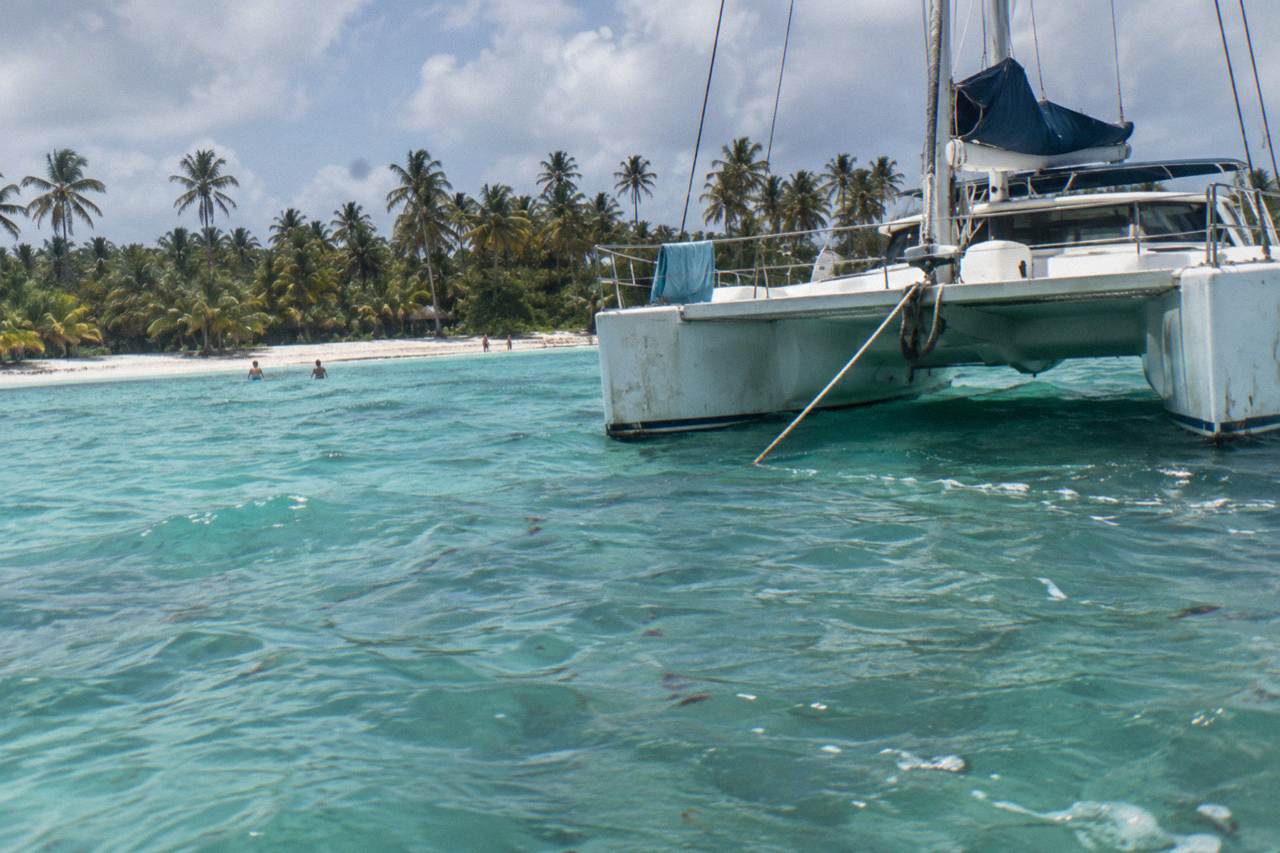
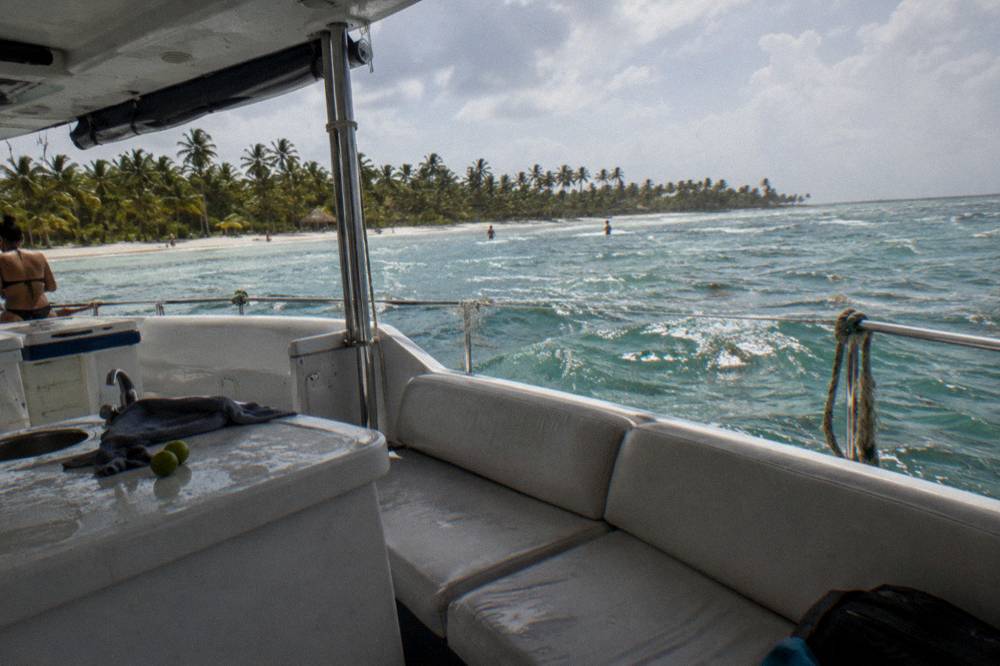
The catamaran itself is a wide, stable platform with netting, deck seating and usually a bar on board. Operators typically run music for the crossing, and the listing for the featured Catamaran Day, Flexible 7 to 11 catamaran tour describes exactly this combination of deck time, drinks and a natural pool stop. Compared with a speedboat, the ride is smoother, drier and far slower, which is either the appeal or the drawback depending on your temperament.
The core itinerary is shared with every other Saona format. Boats stop at the natural pool, a shallow sandbar area where the water sits waist-deep, then land on one of Saona's beaches for a buffet lunch and free time before the return crossing. What differs is the texture of the transit between those fixed points, and that is what you are really choosing when you pick a catamaran tour. The broader shape of the day is covered in the Saona Island day trip guide, which walks through every stop in sequence.
One point worth knowing before anything else: there is no public ferry to Saona. The Ministry of Environment runs the island as part of Parque Nacional Cotubanama, and access is by organized tour boats or informal local boats from Bayahibe. The catamaran tour is not one option among many ways to reach the island, it is essentially the comfortable version of the only way there.
Catamaran Or Speedboat: Which Saona Format Suits You?
Pick the catamaran if you want a stable deck, music, drinks served during the crossing and a slow, social ride, and pick the speedboat if you want the shortest possible time on the water and a thrill on the way. The catamaran crossing usually runs 1 to 2 hours each way against 20 to 60 minutes by speedboat, so the format you choose changes how much of your day is spent boating versus beaching.
Neither format is objectively better; they serve different travelers. Families with small children, anyone prone to seasickness, and groups who see the boat ride as part of the holiday tend to prefer the catamaran. Visitors on a tight schedule, or those who simply want maximum hours on Saona's beaches, often prefer the speedboat and treat the crossing as transit. The Saona Island speedboat tour guide covers that format in detail.
| Factor | Catamaran day | Speedboat day |
|---|---|---|
| Typical crossing time | 1 to 2 hours each way | 20 to 60 minutes each way |
| Ride feel | Stable, walkable deck, netting | Fast, bumpy, spray likely |
| Onboard atmosphere | Music, bar service, socializing | Life jackets on, hold on |
| Who it suits | Families, mixed-age groups, slow-day travelers | Thrill-seekers, tight schedules |
| Typical crowd | Larger shared groups on most departures | Varies, smaller VIP options exist |
| Common pairing | Speedboat out, catamaran back | Same mixed itinerary, reversed |
The mixed itinerary deserves a sentence of its own because it dominates the market. Many listings, including the Saona Island Day Trip from Punta Cana, run speedboat outbound when everyone is eager and catamaran on the return when the open bar and the sun make a slow deck genuinely welcome. If you book one of these, you are not choosing between formats, you are getting both in a fixed order.
Seasickness is the practical tiebreaker for many travelers. A catamaran's twin hulls roll less than a monohull and far less than a bouncing speedboat, but 1 to 2 hours on open water is still 1 to 2 hours on open water. Operators report calmer seas in the December to April dry season, and sea state can still change any given day, so no format comes with a comfort guarantee.
How Much Does A Saona Catamaran Trip Cost?
Group catamaran day trips to Saona run from US$63 to US$116 per person across the 16 catamaran listings on this site, and the median from-price across all 37 per-person tours on the roster is US$100. Lunch and open bar are standard inclusions on most, hotel pickup is included on some Punta Cana and Bavaro tours; check each listing, and only some listings state that the park entry fee is included.
The price ladder is consistent and easy to read once you know the bands. Group catamaran trips sit in the middle of the market, below small group and VIP speedboat options, which run from US$75 to US$169 per person, and far below private boat charters, which are priced per group at US$820 to US$1,490. What you pay for within the catamaran band is mostly departure point, group size and inclusions, so two listings US$30 apart can be nearly identical on the water.
| Tour format | Verified from-price | Basis |
|---|---|---|
| Group catamaran day trip | US$63 to US$116 | Per person, 16 listings |
| Small group and VIP speedboat | US$75 to US$169 | Per person, 16 listings |
| Santo Domingo departure | US$87.90 to US$130 | Per person, 3 listings |
| Private boat charter | US$820 to US$1,490 | Per group, 3 listings |
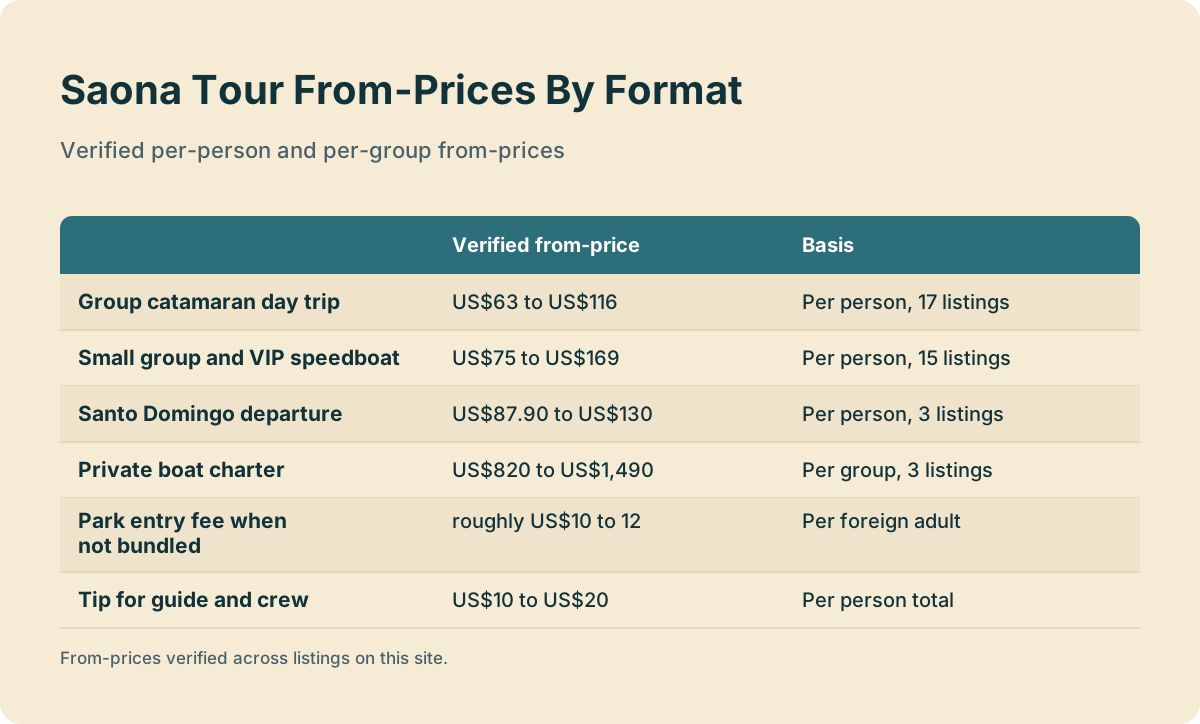
The park entry fee is the line item that catches people out. There is no published official price list: the Ministry of Environment's visitation service page explains that the general public pays by wristband at the site but lists no amounts, and independent visitor guides put it at roughly US$10 to 12 per foreign adult. Many tours bundle it, but only 11 of the 40 listings on this site explicitly state that park entry is included, so read the inclusions on the live listing before assuming. The full breakdown of what is and is not included sits in the Saona Island tour price guide.
Tipping is separate and cash-based. Common guidance for a full-day tour runs US$10 to US$20 per person total for guide and crew, and extras like souvenirs or beach-vendor items cost a few dollars on the day, so bring small bills regardless of how all-inclusive your listing sounds.
What Does The Day Actually Look Like On A Catamaran?
A typical day starts with pickup between roughly 6:30 and 8:00 AM, a road transfer of about an hour from the Punta Cana and Bavaro hotel zones to the Bayahibe pier, then a crossing of usually 1 to 2 hours with a 30 to 45 minute stop at the natural pool, beach time and buffet lunch on Saona, and the return catamaran leg, totaling about 6 to 12 hours door to door.
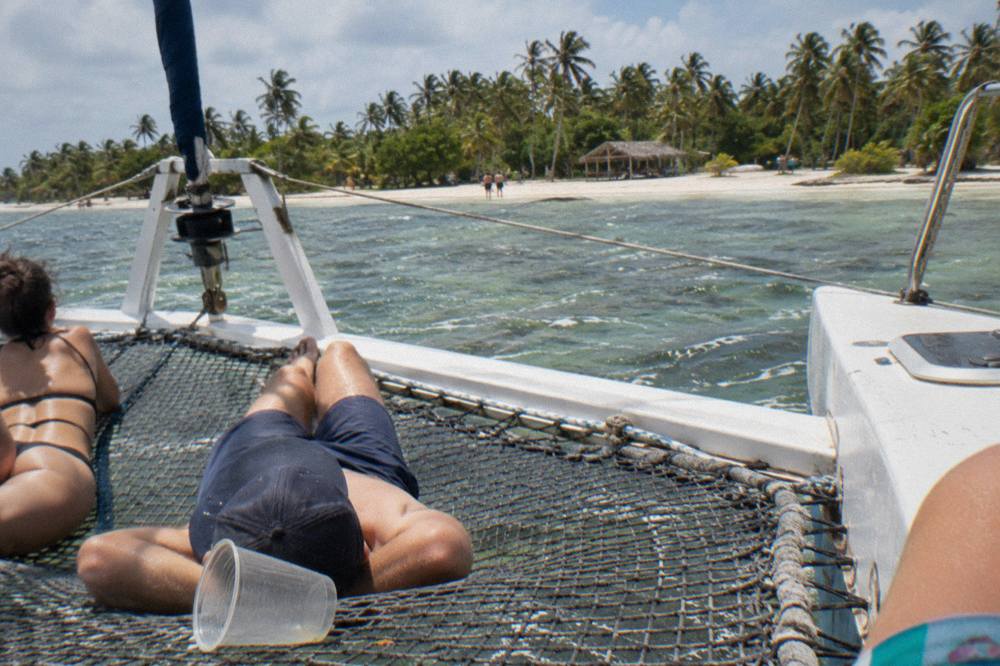
The rhythm is the real product. A speedboat day front-loads the excitement and ends flat; a catamaran day builds slowly. The outbound deck time gives the crew a window to serve drinks, play music and turn 40 strangers into a loose party, and the natural pool stop, where the water is waist-deep and starfish are sometimes visible, works as the warm-up before the island. On Saona itself the day converges with every other format: a Dominican-style buffet, open beach time, and a set meeting time for the boat.
Not every tour includes every stop. Some listings skip the natural pool, some land at Canto de la Playa rather than the main beach, and the mixed speedboat-out itineraries reverse the order entirely. The all-inclusive Punta Cana trip to Saona Island Paradise is one example of the full stack, hotel pickup, buffet lunch, open bar and beach time in a single listing, and the Saona Island itinerary guide walks through how the stops vary across the roster.
The last hour is what catamaran travelers remember, and it is the part no speedboat format replicates. Sun lower, music on, drinks included and nothing to do but watch the Dominican coast approach. If that sentence appeals to you, the format question is already answered.
Where Do Saona Catamaran Tours Depart From?
Every Saona boat, catamaran included, departs from the Bayahibe and Dominicus pier area; there are no boat departures from Punta Cana or Bavaro beaches. Tours sold from Punta Cana and Bavaro hotels include a road transfer of about an hour to the pier, La Romana is about 24 minutes away, and Santo Domingo is about two hours, which is why its departures cost more.
The drive times are measured, not guessed. Free-flow routing puts Punta Cana airport at about 58 minutes from the pier, the Bavaro hotel zone about 59 minutes, La Romana about 24 minutes, and Santo Domingo about 113 minutes. Uvero Alto, at the far end of the Bavaro strip, is the long outlier at about 82 minutes, which explains why some listings quote a wider 60 to 90 minute pickup window for the hotel zones overall.
| Departure point | Drive to Bayahibe pier | Approximate time |
|---|---|---|
| Dominicus | 3.9 km | 6 minutes |
| La Romana | 24.0 km | 24 minutes |
| Bavaro hotel zone | 68.3 km | 59 minutes |
| Punta Cana airport | 69.7 km | 58 minutes |
| Uvero Alto | Longest zone route | 82 minutes |
| Santo Domingo | 133.9 km | 113 minutes |
Staying in Bayahibe or Dominicus changes the economics completely: the pier is minutes away, pickups are late rather than at dawn, and the same catamaran day costs less because nobody is subsidizing your road transfer. The Bayahibe and La Romana departure guide covers that base, and the comparison of the two resort areas is laid out in Punta Cana versus Bayahibe. And if a shared boat sounds too crowded for your group, the guide to private Saona Island tours and their costs explains when paying the premium actually makes sense.
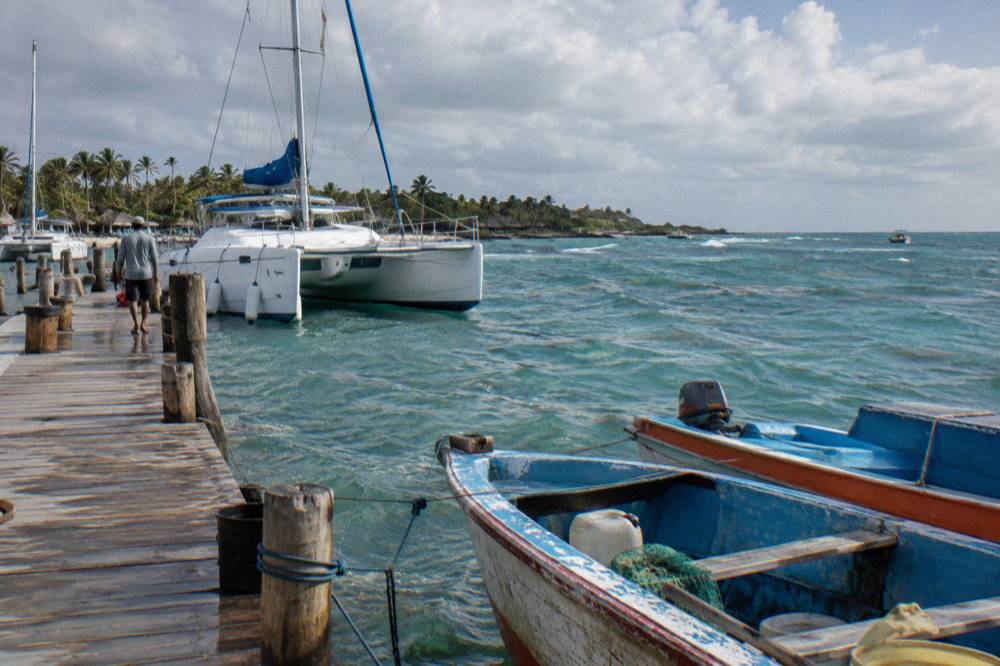
The pier itself was upgraded for exactly this traffic. A new visitor parking facility with sidewalks, drainage and a pedestrian bridge opened at Playa Bayahibe in December 2025, an investment of about RD$213 million aimed at easing congestion around the Saona embarkation points. It does not change your tour, but it does make the pre-boarding wait more orderly than older reviews describe.
What Are The Park Rules On A Catamaran Day?
Saona sits inside Parque Nacional Cotubanama, run by the Ministry of Environment, and three rules shape every catamaran day: entry is paid by wristband at roughly US$10 to 12 per foreign adult unless your tour bundles it, single-use plastic and foam are banned in the park under a 2023 resolution, and you may not remove starfish, shells, coral or sand. Day visits only, no overnight stays.
The plastic and foam ban is not a suggestion. Resolution 0024-2023 was signed by the environment minister at Mano Juan, the village on Saona, and it covers both Parque Nacional Cotubanama and nearby Isla Catalina. In practice it means the boat and the island buffet use reusable cups and plates, and it is why foam coolers and plastic bags are best left at your hotel. The Ministry's own protected-area visitation page sets out the wristband payment system and the school and institution exemptions.
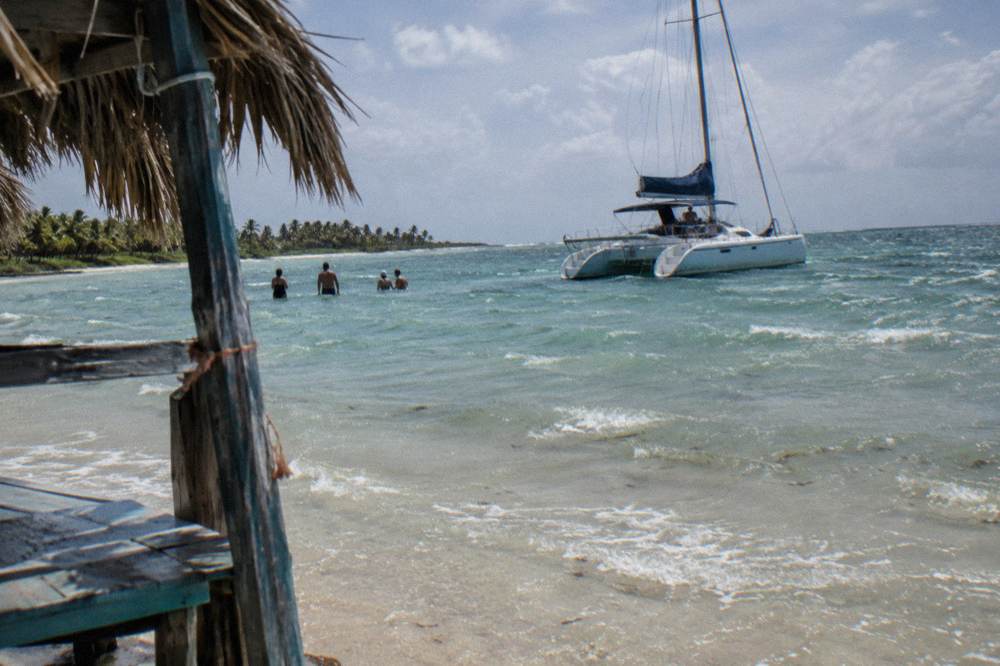
The starfish rule matters most at the natural pool, where starfish are sometimes visible in the shallows. Removing them, or any marine life, shells, coral or sand, is prohibited, and crews on reputable tours repeat this before every swim stop. Operators report that enforcement has tightened, and the natural pool and starfish guide explains what you can and cannot do at that stop specifically.
One administrative note for the wider trip: most air arrivals need no visa for stays up to 30 days, the US$10 tourist card is usually folded into the airfare, and the free E-Ticket entry form is completed online at the official migration portal before arrival. None of it is catamaran-specific, but it is the paperwork that gets you to the pier at all.
Is A Catamaran Saona Tour Right For Families And Older Travelers?
For most families with children and most travelers over about 60, the catamaran is the better Saona format: the deck is walkable, the ride is stable enough to move around on, restrooms are on board, and the longer crossing is social rather than physically demanding. The tradeoffs are earlier fatigue on a long day and a boat shared with a large group, usually 30 or more on shared departures.
The walkability point is the decisive one. On a speedboat, passengers stay seated and hold on for the whole crossing; on a catamaran, children can move between netting, seating and rail, and older travelers can find shade without a safety compromise. The full family angle, including which stops work for which ages, is covered in Saona Island with kids.
| Traveler type | Catamaran fit | Main reason |
|---|---|---|
| Families with young children | Strong | Stable deck, restrooms, space to move |
| Travelers prone to seasickness | Good | Less roll, slower speed |
| Older and mobility-conscious visitors | Strong | Walkable deck, shade, seated boarding |
| Thrill and speed seekers | Weak | 1 to 2 hour crossings feel slow |
| Tight-schedule visitors | Weak | Less island time per hour of day |
Honesty requires the counter-case. A catamaran day is a long day: with pickup from 6:30 to 8:00 AM and 6 to 12 hours door to door, small children and older travelers can hit their limit on the return leg, which is precisely the slow part. A private or small-group option shortens the group-size problem but not the duration, so plan the day around the return, not the beach.
When Is The Best Season For A Catamaran Saona Day?
The December to April dry season is the most reliable window for a catamaran day: lower rain risk, lower humidity and generally calmer seas, with average daytime temperatures around 27 to 30 degrees. September and October are the wettest months, roughly 175 and 158 millimeters on 30-year averages against about 40 in February and March, and hurricane season runs June 1 to November 30 with peak risk mid-August to mid-October.
Calm seas matter more for a catamaran booking than for any other format, because your tour spends more hours on open water. The crossing is usually 1 to 2 hours each way, and operators may alter or cancel trips for rough seas, with refunds typically available when the operator cancels. May, June and November sit in the shoulder: still pleasant, less crowded, and usually cheaper.
Sargassum is the wild card that no season table fully answers. It varies by day, and the southeast coast around Saona is often clearer than the east-facing Punta Cana and Bavaro beaches because the island deflects much of the weed, but that is a tendency, not a promise. Ask the operator about current conditions before you travel; the fuller picture, including the seaweed risk months, is in the best time to visit guide.
Whatever the season, weather on the day wins. A dry-season morning can still blow up choppy and a wet-season day can be glass-flat, so treat every crossing time on this page as the usual range, not a schedule. That is the honest version, and the operator's live listing is the place to confirm the day's plan.
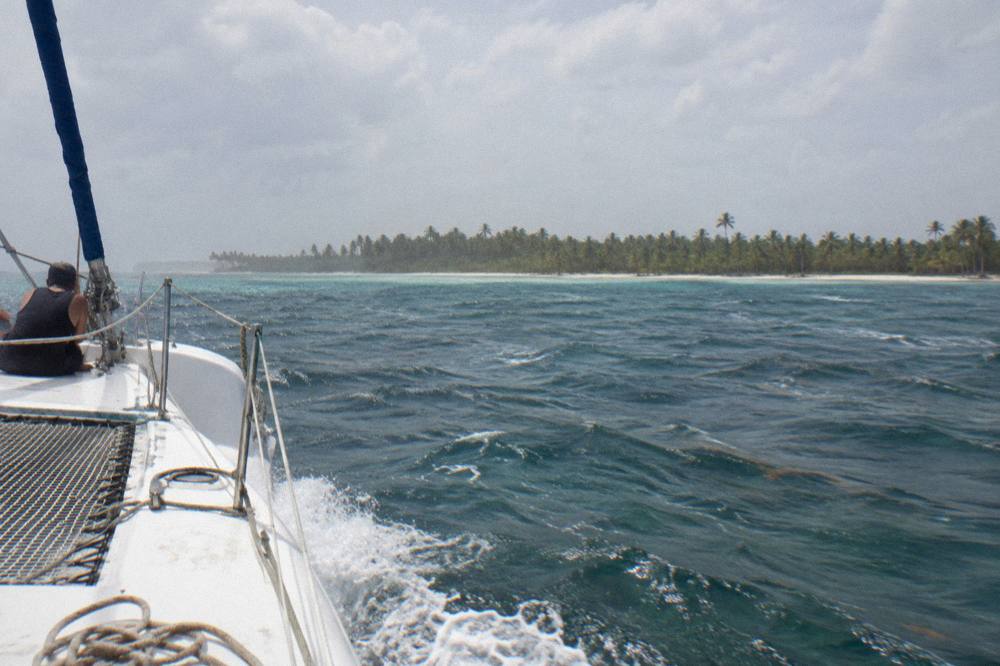
The short version of this whole guide: a catamaran tour trades speed for atmosphere, costs US$63 to US$116 per person in the group band, and turns the crossing itself into part of the day. Travelers who want the cheapest or fastest arrival choose differently, and that is fine. For everyone else, the slow boat from Bayahibe, past Saona Island Dominican Republic Tours and its home waters, is the format that matches what the island actually is: unhurried, warm and best seen from a deck with a drink in hand.
Common Questions About Saona Island Catamaran Tours
How Long Is The Catamaran Ride To Saona Island?
Usually 1 to 2 hours each way by catamaran, depending on sea conditions and operator, against 20 to 60 minutes by speedboat. The full tour runs about 6 to 12 hours door to door including road transfer and island time.
How Much Does A Saona Island Catamaran Tour Cost?
Group catamaran day trips run from US$63 to US$116 per person across the verified listings on this site. Lunch and open bar are standard inclusions, and hotel pickup is listed on Punta Cana and Bavaro departures.
Is The Park Entry Fee Included In A Catamaran Tour?
Only some listings state it. Eleven of the 40 tours on this roster explicitly include national park entry; the rest are silent, and the fee runs roughly US$10 to 12 per foreign adult per independent visitor guides, since the Ministry publishes no price list. Check the inclusions on the live listing to avoid paying twice.
Catamaran Or Speedboat, Which Is Better For Saona Island?
The catamaran suits families, mixed-age groups and anyone who wants a stable, social deck with drinks served on the crossing. The speedboat suits tight schedules and thrill-seekers who want the shortest crossing. Many tours combine both: speedboat out, catamaran back.
Do Saona Catamaran Tours Depart From Punta Cana?
Boats leave only from the Bayahibe and Dominicus pier area. Punta Cana and Bavaro tours include a road transfer of about an hour to the pier, with pickups usually starting between 6:30 and 8:00 AM.
What Is The Best Month For A Catamaran Day To Saona?
December to April, the dry season, offers the most reliable combination of sun, calm seas and lower rain risk. May, June and November are good shoulder-value months; September and October are the wettest.