What Movie Was Filmed On Saona Island?
The Pirates of the Caribbean story about Saona Island is everywhere, but is it true? A plain look at what is verified, what is legend, and how to see the island's famous beaches for yourself.
No film title can be confirmed for Saona Island. The Pirates of the Caribbean association is repeated constantly in tourism copy, but credible reporting places that production elsewhere, and no primary source confirms scenes were shot on Saona. What is documented is that the Dominican film commission lists the island as a filming location, without naming any production, and that Bounty ran commercials here according to tourism sources.
The short answer frustrates people, because the long answer is the one everybody already knows. Type the island's name into a search bar and page after page repeats some version of the same sentence: Saona Island, backdrop to Pirates of the Caribbean, the Caribbean paradise where Jack Sparrow walked. Tour descriptions lean on it. Hotel concierges repeat it. Blog posts present it as settled fact with the confidence of an encyclopedia entry.
When the claim is traced backward, it thins out quickly. The films in the franchise were shot at multiple real locations, and credible reporting on the productions places the Caribbean work in places other than Saona. No shooting log, no production note, no crew account puts a Pirates camera on this island. What exists instead is a feedback loop: one tourism source copies another, a Spanish Wikipedia line repeats the claim, and the sentence hardens into fact through sheer repetition.
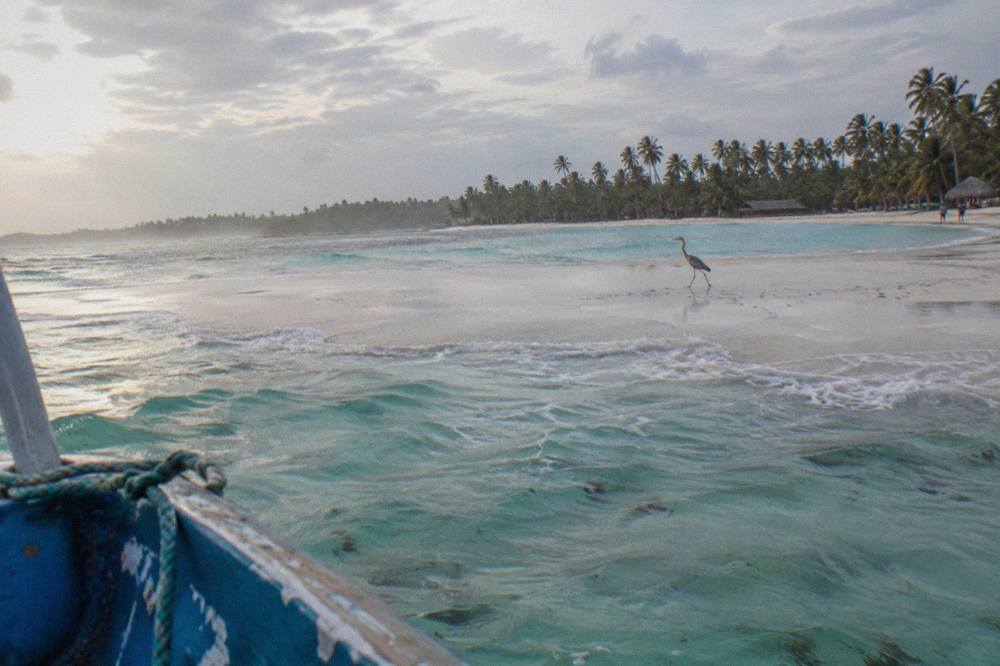
That does not make the island a fraud. It makes it a place whose real appearance outperforms the legend attached to it. The beaches, the natural pool, the village of Mano Juan and the protected waters of Parque Nacional Cotubanamá draw a steady year-round flow of visitors, and most of them arrive on ordinary catamaran and speedboat day trips that never mention a movie at all. For travelers who want to stand on the beaches themselves, the all-inclusive Saona Island Paradise trip from Punta Cana, the standard Saona Island day trip from Punta Cana, and the smaller-group Saona Island unique experience are three of the most direct ways to do it, and listings from Punta Cana typically run about $71 to $89 per person for the full-day format with lunch and an open bar.
The rest of this article walks through each filming claim in turn, separates the documented from the repeated, and then covers the practical side: what a day on the island actually costs, how the crossing works, and which tour format fits the version of the island you came for. The deeper dive into the pirate connection itself continues in our Saona Island Pirates of the Caribbean guide, which follows the paper trail in more detail.
What Movie Was Filmed In Saona Island?
The honest answer to what movie was filmed in Saona Island is: none can be verified by name. The Pirates of the Caribbean claim is the popular answer, but it rests on tourism sources and a single Spanish Wikipedia line, not on production records. The Dominican film commission does list Saona as a location, yet it names no production for the island, so no title can be stated as fact.
Start with the strongest piece of evidence people cite, because it deserves to be taken seriously rather than dismissed. The Dominican Republic's film commission, the body that permits and promotes productions in the country, does include Saona Island among its registered locations. That is real. A protected Caribbean island with shallow turquoise water, palm lines and a fishing village is exactly what a location scout wants on file.
But a location listing is not a shooting record. The commission's entry for the island names no production, no year, no scene. It means Saona is available and photogenic, the same way a casting sheet means an actor is available, not that they got the part. Everything else stacked on top of that entry, the Pirates claim above all, comes from tourism copy and a Spanish Wikipedia line that itself cites no primary source.
The Pirates of the Caribbean franchise did shoot in the Caribbean, which is part of why the claim feels plausible. The confusion is understandable: the films are set in exactly this kind of landscape, and the eastern Dominican Republic markets itself heavily on pirate-era history, shipwrecks and colonial architecture. Santo Domingo's colonial zone, the oldest European city in the Americas, appears in plenty of filming conversations about the country. But the jump from "the Caribbean" and "the Dominican Republic" to "Saona Island specifically" is where the evidence disappears.
The plain answer to the movie question: the Pirates of the Caribbean association with Saona Island is widely repeated but unverified., and notes that credible reporting places the film elsewhere. That is why no page here will ever tell you Jack Sparrow stood on Canto de la Playa. It might be true. Nobody who actually knows has said so on the record.
Here is where each piece of the legend stands, side by side:
| Claim | Where it comes from | What the evidence supports |
|---|---|---|
| Pirates of the Caribbean filmed scenes on Saona | Tourism sites, tour descriptions, one Spanish Wikipedia line | Repeated widely, confirmed nowhere; credible reporting places the production elsewhere |
| Bounty filmed commercials on Saona | Tourism sources and the same Spanish Wikipedia line | Plausible and frequently stated, but still secondary; no brand-side confirmation |
| Saona is a registered film location | The Dominican film commission's location listings | True; the island is listed, with no production named |
| A specific scene or title was shot on the island | Nowhere verifiable | Not supported; no title, scene or shooting log exists to cite |
For readers whose interest in the legend is really an interest in the place, the practical path is straightforward. The island is a paid, permitted day-trip destination inside a national park, reached by organized boats from the Bayahibe pier, and the standard all-inclusive format from Punta Cana, with hotel pickup, buffet lunch and open bar listed, runs about $71 to $89 per person on current listings. Park entry is bundled into many tours; where it is not, the fee runs roughly US$10 to 12 per foreign adult according to independent visitor guides, and the Ministry publishes no price list, so confirm with your operator.
What Movie Was Filmed At Saona Island?
Asked as what movie was filmed at Saona Island, the answer shifts slightly: the best-documented screen work connected to the island is commercial, not cinematic. Tourism sources credit Bounty paper towel commercials with filming on Saona's beaches, a claim that also traces back to a Spanish Wikipedia line rather than a brand announcement. No feature film title can be attached to the island with confidence.
The Bounty story is the quiet sibling of the Pirates story, less famous but on marginally firmer ground. The logic behind it is easy to picture: a commercials crew needs exactly one shot of an impossibly clean, impossibly white beach, and Saona's sandbars and shallow water deliver that without set construction. The filming story gets repeated everywhere but leaves no paper trail the way a feature production does, which is both why the claim is hard to confirm and why it is easy to believe.
That asymmetry matters for how you read every filming claim about small islands. A major studio film generates permits, local hiring, equipment logistics and news coverage. A commercial generates a day of activity and a memory among the boat crews. When the only sources for a claim are tourism pages and an unsourced encyclopedia line, the more likely explanation is the smaller production, or no production at all, rather than a blockbuster that somehow avoided every local newspaper.
It is also true that the Dominican Republic as a whole has a real screen industry, and that reality gets blurred into island-level claims. The country offers competitive film incentives, and productions of various sizes have used its colonial cities, beaches and mountain roads. But "filmed in the Dominican Republic" covers a lot of geography, and the leap to a specific protected island inside a national park requires specific evidence that, for Saona, does not exist in public form.
None of this changes the visitor experience, which is the honest punchline of the whole question. The natural pool stop, usually 30 to 45 minutes in the water on mixed itineraries, and the long beach afternoons at Canto de la Playa or the main beach look like film sets because the standard for what a "perfect Caribbean beach" looks like was partly set by places like this. Whether a camera ever rolled here is a trivia question. The sand is the same either way.
Why The Pirate Legend Sticks Anyway
The pirate legend survives because it fits what visitors actually see. Saona sits inside a protected national park with no development on its main beaches, so the shoreline genuinely looks like an untouched film set, and the Dominican Republic's real colonial and shipwreck history gives the story a plausible backbone. The island does not need the movie credit to justify the trip.
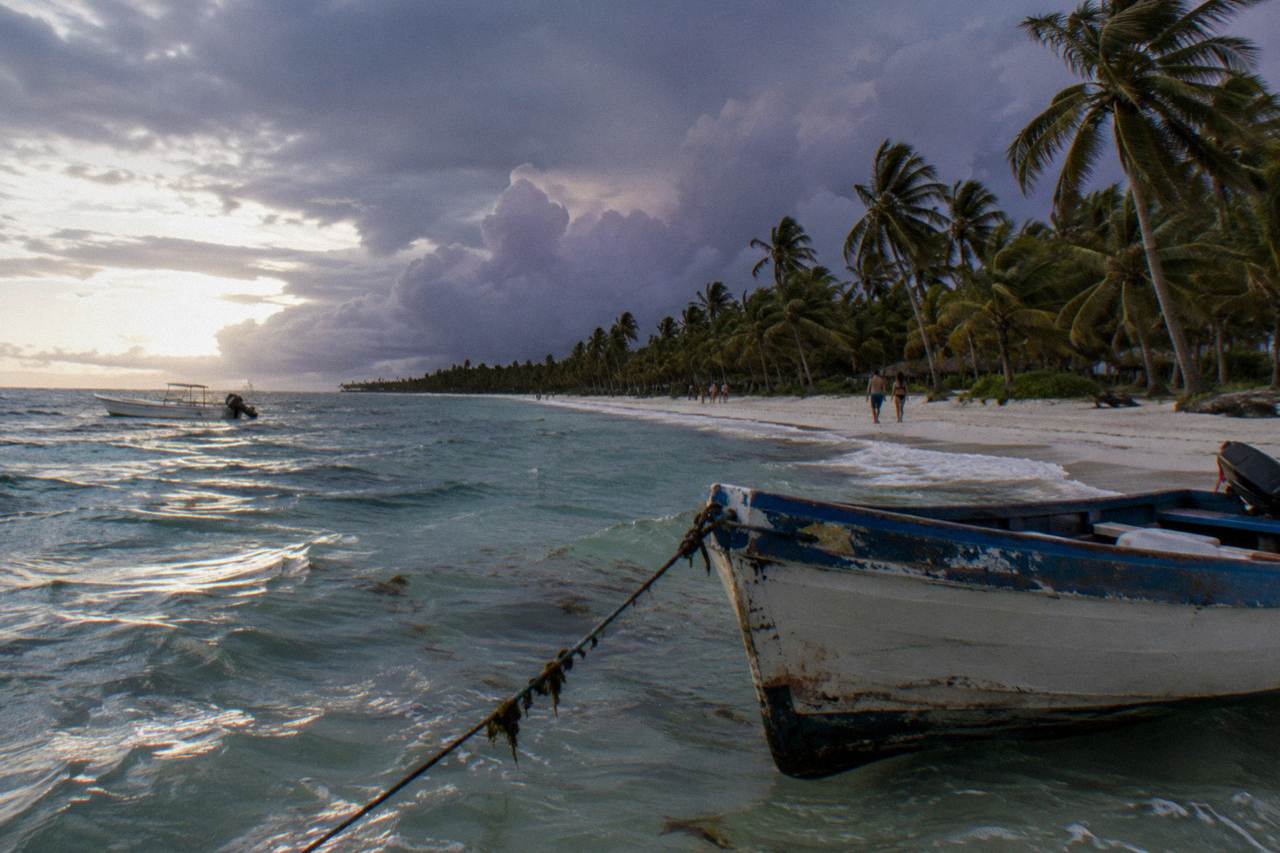
There is a useful distinction between a place being cinematic and a place being filmed. Saona is unarguably the first. Parque Nacional Cotubanamá, administered by the Ministry of Environment, keeps the island day-use only, with no hotels on the main beaches and no construction crowding the palm lines. Walk from the boat landing toward Canto de la Playa and the scene is closer to a concept painting than to a resort beach: white sand, shallow gin-clear water, thatch and fishing boats. Visitors respond to that, and tour marketing responds to visitors. The rest of the planning pages sit on Saona Island Dominican Republic Tours.
The legend also survives because pirates themselves are not fiction in this region. The southeastern Dominican coast has centuries of real buccaneer history, from Santo Domingo's walled colonial city to the shipwrecks that still attract divers off Bayahibe and Catalina. When a guide mentions pirates on the ride out, they are standing on genuine history even when the movie connection is embellished. The Bayahibe snorkeling and diving guide covers the wreck sites that give that history a physical anchor you can actually swim over.
The third reason is simple economics. "Beach where a blockbuster filmed" sells better than "very beautiful protected beach," and the sentence gets copied because it works. Every season, boats full of visitors ask the movie question on the crossing, and every season the answer gets retold with more certainty than the evidence supports. The claim became true-ish through repetition, the way island legends do.
None of which should dim the actual product on offer. The protected status that makes the island look like a set is also what makes the day trip worth taking: reef-safe sunscreen rules, a ban on single-use plastic and foam in the park under the Ministry's 2023 resolution, and firm rules against removing starfish, shells, coral or sand. The natural pool, the starfish sightings and the palm-shaded lunch stops are the real attractions, and they need no cinematic pedigree.
What A Saona Day Trip Actually Looks Like
A standard Saona day runs about 6 to 12 hours door to door: road transfer to the Bayahibe pier, a speedboat crossing of usually 20 to 60 minutes or a catamaran crossing of 1 to 2 hours, a 30 to 45 minute stop at the natural pool, then beach time and a Dominican buffet lunch before the return leg. Mixed itineraries often take the speedboat out and the catamaran back.
The morning starts early because the ocean does. Pickups from Punta Cana and Bavaro hotels usually begin between 6:30 and 8:00 AM, depending on the hotel zone, and the drive to the Bayahibe pier runs about an hour from the Bavaro hotel zone per routing data, with operators quoting 60 to 90 minutes in practice. From La Romana the drive is about 24 minutes; from Dominicus, about 6. All Saona boats leave from the Bayahibe and Dominicus pier area, so every Punta Cana or Bavaro departure is a road-plus-boat combination by design.
Once on the water, the format you chose shapes the day. Large group catamaran trips, typically $63 to $116 per person across the current roster, trade intimacy for atmosphere: music, open bar from mid-morning, and a slow scenic crossing. Small group and VIP speedboat trips, $75 to $169 per person, prioritize time on the island over time getting there. Private charters, priced per group from $820 to $1,490, let a family or friend group set their own rhythm entirely. The median per-person price across the roster sits at $100.
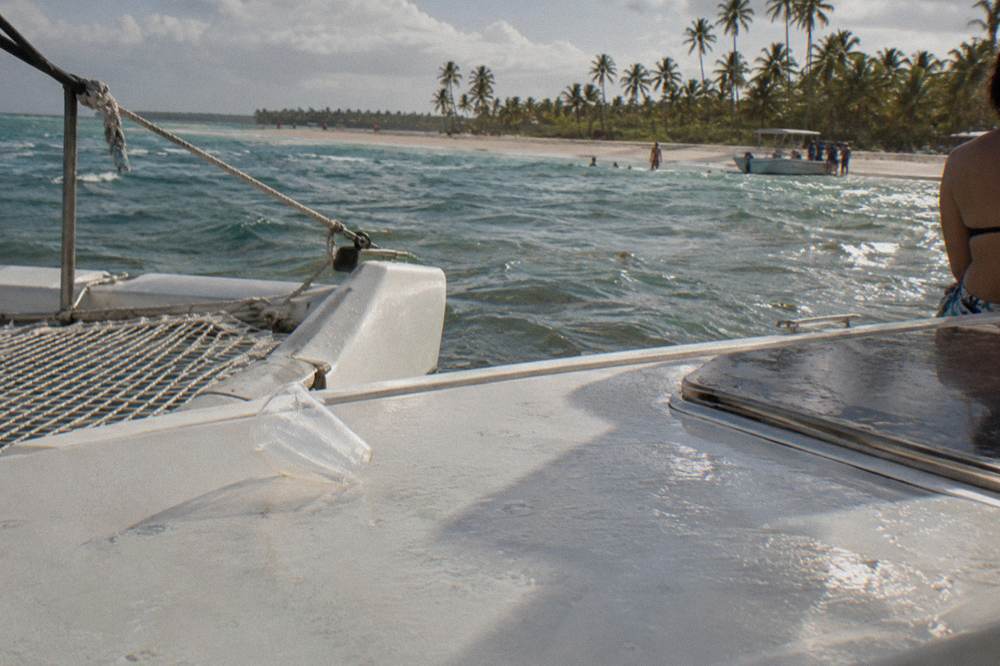
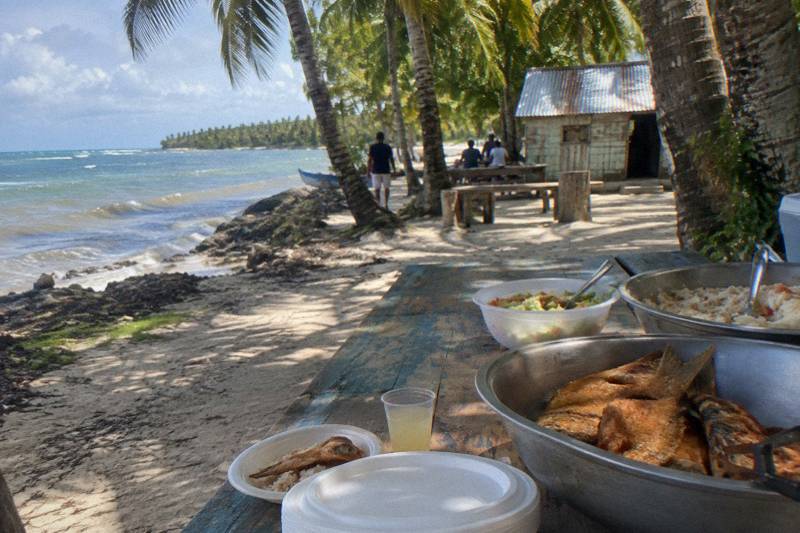
The natural pool stop is the signature hour. Operators report the sandbar stop typically runs 30 to 45 minutes, in water shallow enough to stand, with starfish commonly visible; the rules are strict and worth repeating: look, do not touch, and take nothing. Afterward the boat moves to the island itself, where the standard itinerary includes beach time and a buffet lunch of Dominican fare, grilled chicken or fish, rice, salads and fruit, with drinks served through the day. Not every tour includes every stop, so read the listing's itinerary before booking.
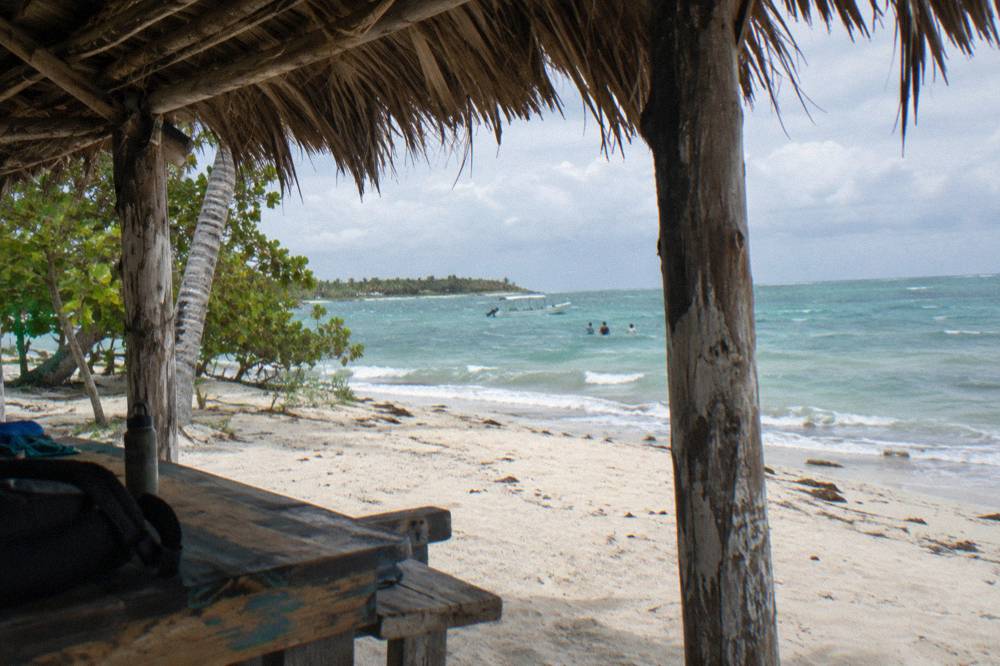
The smaller-group format deserves a specific mention for readers who came for the scenery rather than the party. The Saona Island unique experience, one of the roster's distinct formats, caps the crowd and keeps the day closer to the island's actual character: quiet water, the village at Mano Juan, and beach time that does not compete with a sound system. After the natural pool and the main beach, it is the format most likely to feel like the unpeopled film-set version of the island the legends describe.
What The Trip Costs, In Verified Numbers
Verified listing prices for Saona day trips span $63 to $116 per person for group catamaran trips, $75 to $169 for small group and VIP speedboat formats, and $87.90 to $130 for Santo Domingo departures, with private charters at $820 to $1,490 per group. The median per-person price across the roster is $100, and many tours bundle the park entry fee, which otherwise runs roughly US$10 to 12 per foreign adult.
These are from-prices read across the 40 listings this site tracks, and they behave the way live prices always do: they move with season and demand. December through April, the dry season, is when the top of each range is most likely to apply, and also when the island is busiest. May, June and November sit in the shoulder, wetter on paper but often pleasant, with softer prices and thinner crowds.
| Tour format | Verified from-price range | Basis | Typical character |
|---|---|---|---|
| Group catamaran day trip | $63 to $116 | per person | Large group, open bar, party-leaning crossing |
| Small group and VIP speedboat | $75 to $169 | per person | Faster crossing, capped headcount |
| Santo Domingo departure | $87.90 to $130 | per person | Longest door-to-door day, about 2 hours by road each way |
| Private charter | $820 to $1,490 | per group | Custom itinerary, own boat and crew |
Two costs sit outside the sticker. Tips are not included anywhere in the roster; a common recommendation for a full-day tour is US$10 to $20 per person for guide and crew, in cash. And extras on the island, souvenirs, photos, premium drinks, cost a few dollars paid on the day. The all-inclusive formats, including the featured Saona Island Paradise trip, minimize the surprise line items by putting lunch, drinks and transfer in the listed price, and the Buffet Lunch Catamaran Day listing starts at $71.20 per person from Punta Cana.
Park entry deserves one careful sentence. Eleven of the 40 tours this site tracks explicitly list national park entry as included; the other 29 say nothing, which is not the same as excluding it. Where it is not included, the fee runs roughly US$10 to 12 per foreign adult according to independent visitor guides; the Ministry publishes no price list and collects by wristband at the site, so confirm with your operator before you go to avoid paying twice.
Planning Notes: Getting There And Timing It Right
All Saona boats depart from the Bayahibe and Dominicus pier area, so the choice of tour is really a choice of transfer: about an hour by road from Punta Cana or Bavaro, about 24 minutes from La Romana, and about two hours from Santo Domingo. December through April offers the most reliable weather; September and October carry the highest rainfall, about 175 mm at the wettest, against roughly 40 mm in the driest months of February and March.
Timing matters more on this trip than on most, because the crossing is weather-dependent. Operators may cancel or reroute for rough seas, and policies typically allow a full refund when the operator cancels. The dry season, December to April, brings the calmest seas and the most dependable sunshine, at the cost of peak crowds. The wet season, May to November, brings brief heavy showers rather than all-day rain, but September and October also sit inside the Atlantic hurricane season's peak window, which runs mid-August to mid-October.
Sargassum deserves a fair sentence too, since it is the question savvy readers ask after the movie question. 2026 was a heavy sargassum year across the Caribbean, but Saona's south and west beaches are often clearer than the east-coast resort beaches because the island deflects much of the weed westward. Often, not always: conditions vary by day, and the honest move is to ask your operator the morning of the trip. Monitoring outlooks in late 2026 pointed toward declining abundance through November onward.
For the practicalities of choosing a format, the deeper comparisons live elsewhere on this site: the Saona Island tour types compared guide breaks down catamaran versus speedboat versus private, and the question of what is special about Saona Island covers the geography that makes the island photograph like a set in the first place. Entry formalities for the country itself are simple for most visitors: no visa needed for stays up to 30 days for most North American and European nationalities, with the free E-Ticket form filed online before arrival at the official migration portal.
The park rules, worth knowing before you board, come straight from the Ministry of Environment, which administers Parque Nacional Cotubanamá. Single-use plastic and foam are banned inside the park, reef-safe sunscreen is recommended, and removing starfish, shells, coral or sand is prohibited. The Ministry's protected-area visit service page explains the wristband payment system and the day-use rules in the Ministry's own words.
Common Questions About Saona Island Movies
What Movie Was Filmed On Saona Island?
No title can be confirmed. The Pirates of the Caribbean claim is repeated everywhere in tourism copy but traces to no primary source, and credible reporting places that production elsewhere. The Dominican film commission lists Saona as a location without naming any production, and tourism sources credit Bounty commercials on the island, which is the closest thing to a documented screen connection.
What Movie Was Filmed In Saona Island?
The popular answer is Pirates of the Caribbean, but it is unverified. The claim circulates through tourism sites and a Spanish Wikipedia line that cites nothing. The film commission's location listing for the island names no production, so no movie can be stated as fact.
What Movie Was Filmed At Saona Island?
No feature film is confirmed. The best-supported screen work is commercial: tourism sources say Bounty filmed advertisements on Saona's beaches. Even that rests on secondary sources rather than a brand confirmation.
Was Pirates Of The Caribbean Actually Shot In The Dominican Republic?
Parts of the Caribbean appear throughout the franchise, and the Dominican Republic has a real film industry with locations registered with its film commission. But no verified record places Pirates of the Caribbean scenes on Saona Island specifically, and credible reporting on the production points elsewhere.
Can You Visit The Beaches The Legends Are About?
Yes, on organized day trips. Boats leave from the Bayahibe pier, usually a 20 to 60 minute speedboat crossing or 1 to 2 hours by catamaran, with group trips from $63 per person and private charters from $820 per group.