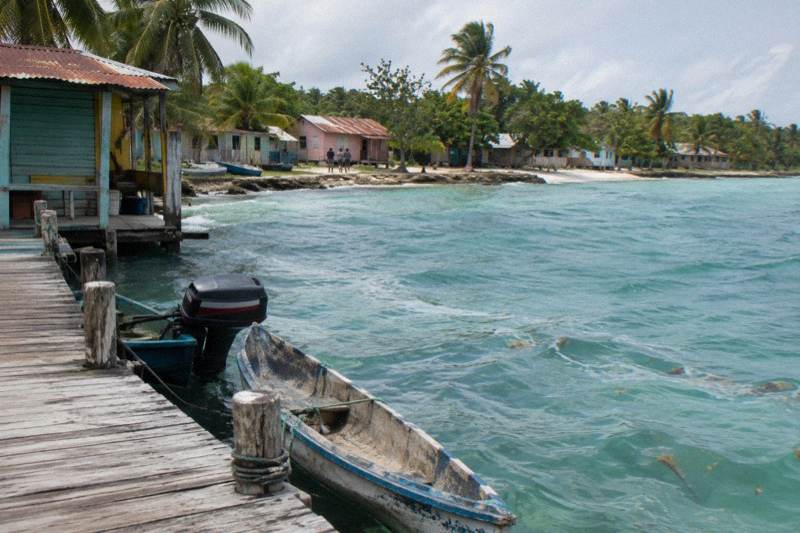
Mano Juan And The Saona Turtle Sanctuary: Stops Explained
Most Saona day trips sell the beach and the natural pool, and only some of them include the fishing village of Mano Juan and its turtle sanctuary. This guide explains what the stop actually is, which tour styles visit it, and how to verify the detail before booking.
Short answer
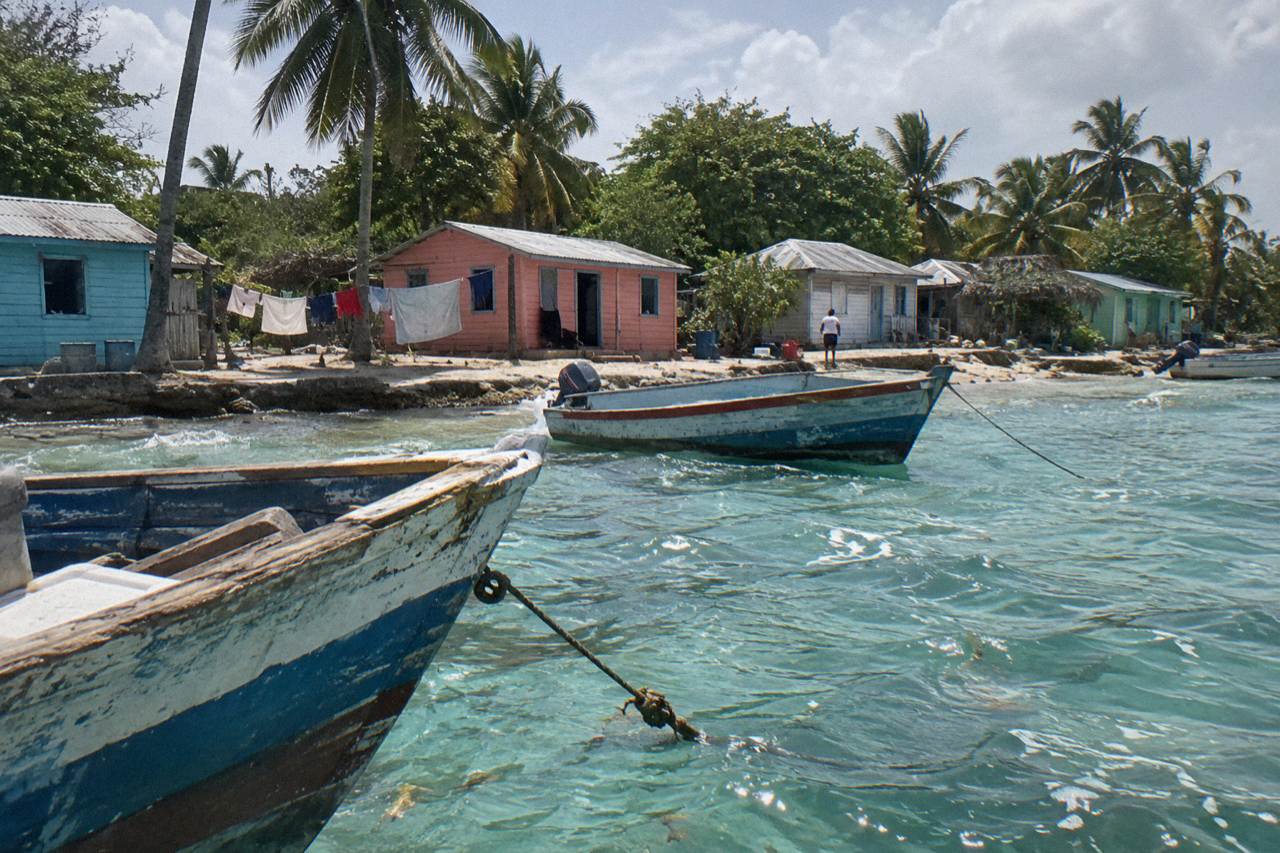
Mano Juan is a small fishing village inside Parque Nacional Cotubanamá, and its turtle sanctuary is sometimes included as a stop on tour itineraries. Not every Saona tour stops there: mixed catamaran and speedboat itineraries and small group VIP trips are the ones most likely to list it, so read the itinerary before booking.
Saona Island is usually sold as two stops: a natural pool in the sea and a long white beach with a buffet lunch. A third stop exists, and for many travelers it is the one they remember longest. Mano Juan is a real fishing village of wooden houses and sandy lanes on the island's south side, and beside it runs a small turtle sanctuary where hatchlings are raised and released back into the Caribbean. The stop is short, usually part of a wider itinerary, and it appears on some listings but not on others, which is exactly why it deserves its own explanation.
The tours most likely to include it are the mixed itineraries that visit several beaches rather than one. A catamaran trip listing Mano Juan, Canto de la Playa and the natural pool names all three stops in its own title, which removes the guesswork. Small group and VIP speedboat products such as the VIP four beaches itinerary also route through the village on their multi-stop days. This guide lays out what the stop is, which tour families include it, and how the park rules shape what you can and cannot do there. If you're deciding which of those beach stops to care about most, our guide to Saona Island's prettiest beach compares Canto de la Playa with the other stretches of sand your tour might include.
What Is The Turtle Sanctuary On Saona Island?
The Saona turtle sanctuary is a small, locally run hatchery next to Mano Juan village that raises sea turtle hatchlings in tanks and releases them into the sea, and it is one of the few conservation projects inside Parque Nacional Cotubanamá that day visitors can actually see. It is not a research station with public galleries or a guarantee of touching animals. It is a modest facility, often tended by villagers, where tiny turtles are held in seawater pools until they are large enough to stand a better chance in the open sea. Visitors who stop here typically get twenty to forty minutes: a look at the tanks, a short explanation of the work, and sometimes the chance to watch a release if the timing lines up. No part of the visit involves handling wildlife on demand, and the park's rules on marine life apply here as strongly as anywhere else on the island.
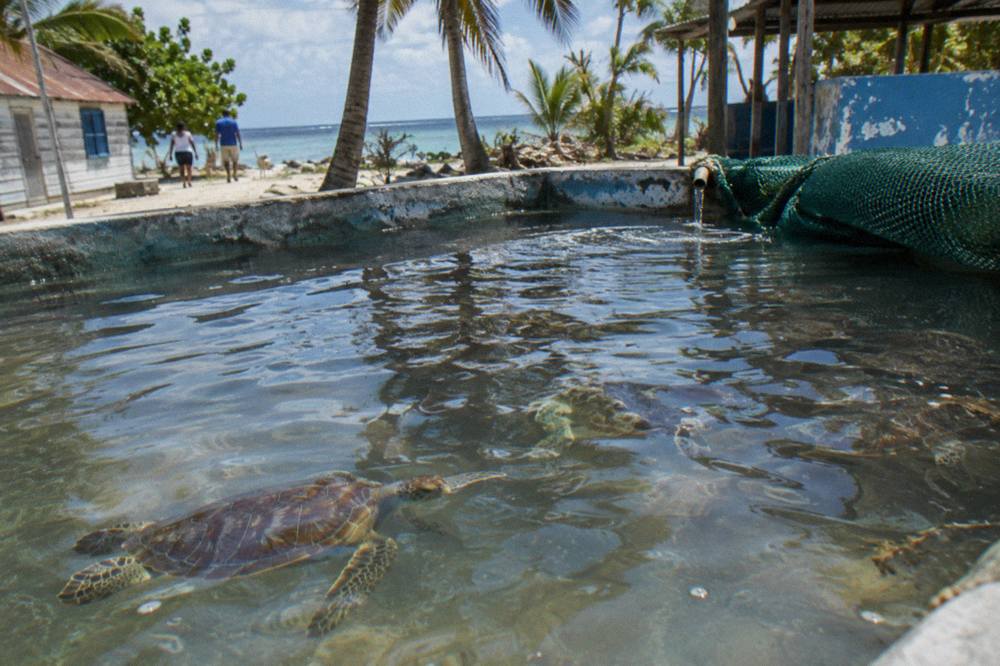
The sanctuary's work matters because Saona sits inside a protected area where sea turtles nest on quiet beaches. The Dominican Ministry of Environment, which runs the park, describes public visits in terms of a wristband payment system and permits day use only, with no overnight stays booked outside official channels; its protected-area visit service page explains how entry and bookings are administered, without publishing any price list. The hatchery plugs into that same framework. Eggs laid in exposed spots are sometimes relocated, hatchlings are head-started in tanks, and releases are timed with the seasons. None of this is staged for cameras, which is part of why the stop feels different from the beach clubs.
What the sanctuary is not: it is not a zoo, not a swim-with-turtles attraction, and not an optional paid add-on with a ticket booth of its own. Access comes with the tour that stops there. Travelers who want the stop should treat it the way they treat any itinerary detail, as something to verify on the live listing before paying, because operators adjust routes for sea state, weather and crowds. Ask the operator directly whether the village stop is scheduled for your date, since conditions on the water, not marketing, decide the final order of the day.
Which Saona Tours Actually Stop At Mano Juan?
Tours that stop at Mano Juan are almost always the multi-stop itineraries, catamaran and speedboat combos, and small group or VIP products that name the village and Canto de la Playa in their listing titles, while classic single-beach group trips with a natural pool stop often skip the village entirely. The distinction is not price, it is route design. A tour built around one long beach day spends its time at the main strand and the piscina natural, while a tour built around seeing the island strings several stops together. Across the current roster, the listings that mention Mano Juan sit in the small group, VIP and catamaran families, and group catamaran day trips from Bayahibe and Punta Cana start from about US$63 to 116 per person, with small group and VIP speedboat trips from about US$75 to 169, per the verified price ranges.
The comparison worth making before booking is not between operators but between itinerary shapes. The table below sums up how the main Saona tour families treat the village stop, using only what the roster and operator guides support.
| Tour family | Typical village stop | Who it suits | What to verify on the listing |
|---|---|---|---|
| Group catamaran day trip | Sometimes, usually brief or skipped | Budget travelers, first timers | Whether Mano Juan is named in the itinerary |
| Speedboat out, catamaran back | Often included as one of several stops | Travelers who want pace and variety | Order of stops and time allotted at the village |
| Small group or VIP speedboat | Frequently included, longer stop | Families, photographers, turtle-focused visitors | Group size cap and whether the sanctuary entry is included |
| Private charter | Fully customizable | Groups celebrating, cruise parties | That the operator confirms the village stop in writing |
Of the listings above, one names Mano Juan in its title; the others leave it as a stop on the day, which is the cleanest signal a buyer can get. The VIP four beaches product and the four beaches Punta Cana departure both route around the island's south shore, where the village sits. The catamaran trip adds Canto de la Playa, the stretch of sand most often photographed for Saona, so a single day covers the village, the turtle tanks, the famous beach and the natural pool. For a wider comparison of itinerary shapes, see the guide to Saona Island tour types compared.
What Do You See And Do In Mano Juan Village?
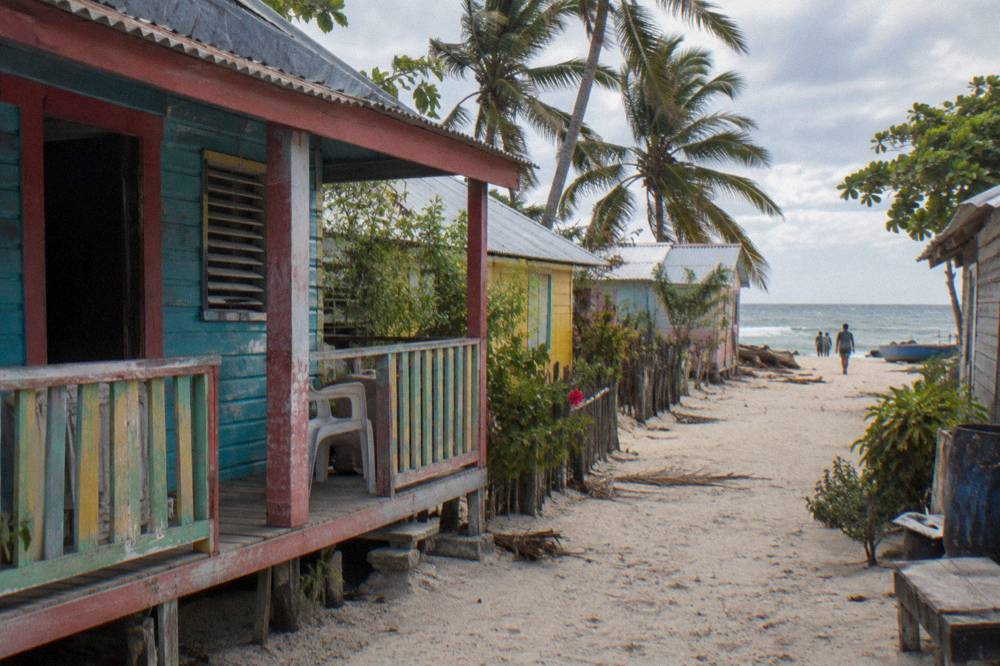
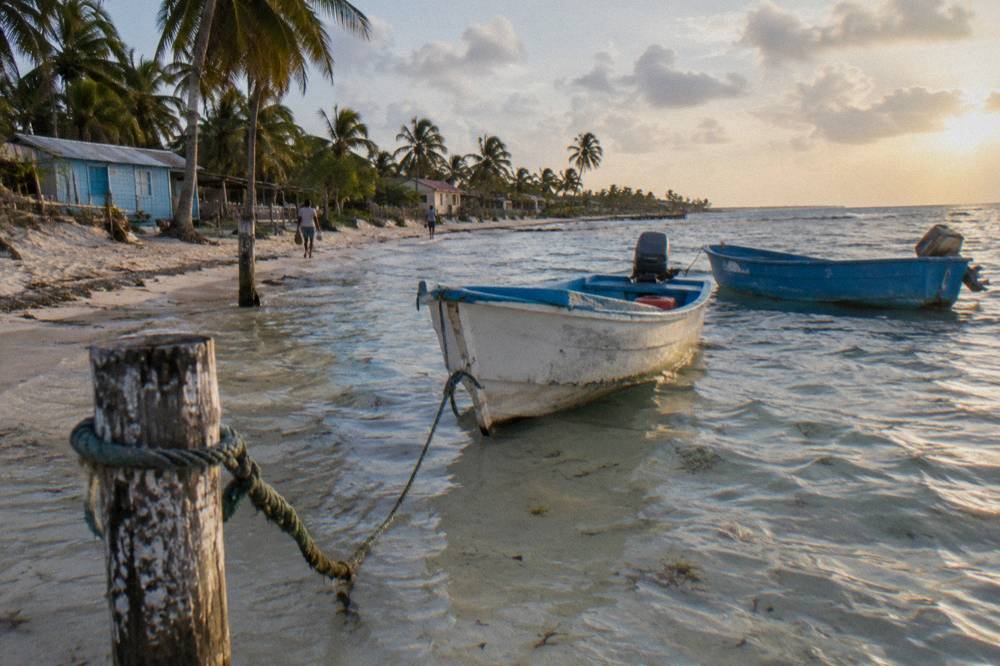
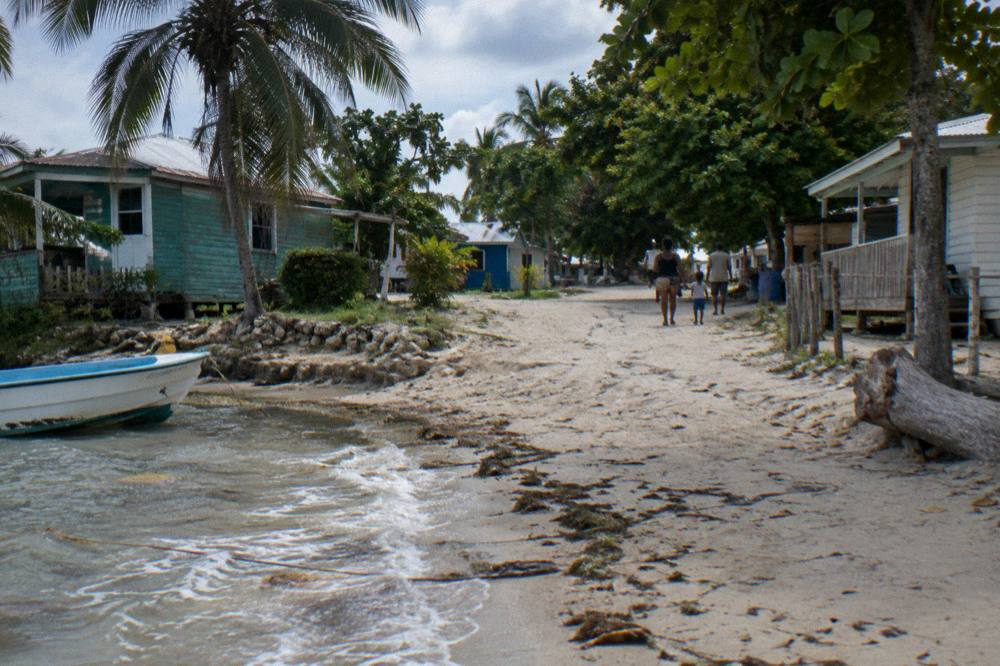
Visitors to Mano Juan walk its sandy lanes between painted wooden houses, see the turtle sanctuary tanks, browse a few small craft stalls run by villagers, and typically spend twenty to forty minutes ashore before the boat moves on to the next stop. The village is home to a small year-round community, one of the only permanently inhabited parts of the island, and it looks the part: a working fishing village, with boats at the waterline and everyday life on view during the village walk. There is no boardwalk, no chain anything and no pressure to buy. The craft stalls sell shellwork, carvings and simple jewelry, and prices are negotiated in person with cash.
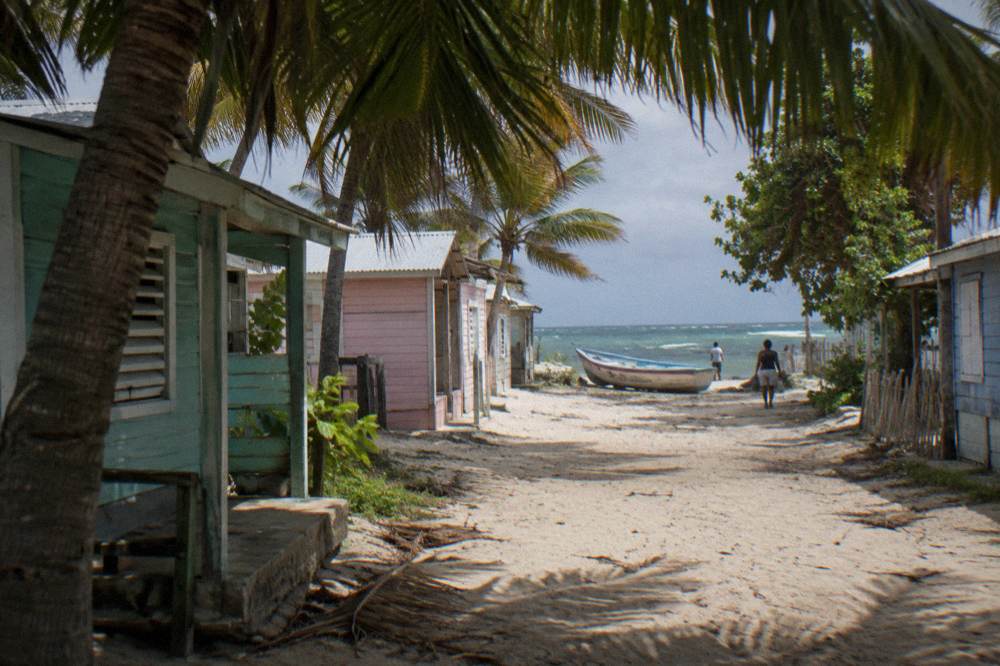
The stop rewards travelers who slow down. Ten minutes buys the sanctuary and a photograph. Half an hour buys a conversation with a stallholder, a look at the boats, and a sense of what a protected national park with residents in it actually means. The Ministry bans single-use plastic and foam throughout Parque Nacional Cotubanamá under its 2023 resolution, and Mano Juan is where that rule is most visible: villagers live with the ban, and visitors are expected to respect it. The park also prohibits removing starfish, shells, coral or sand, a rule enforced on every landing beach including the village shore.
A practical note on money and timing: bring small US bills or Dominican pesos for the stalls, since card payment is not part of village life, and keep an eye on the guide's timing. Village stops are short by design, and the boat leaves when the itinerary says so. Travelers pairing the village with the natural pool can read more about that stop in Saona Island natural pool and starfish, which explains the no-touch rules for the starfish that gather there.
How Does The Village Stop Fit Into A Full Saona Day?
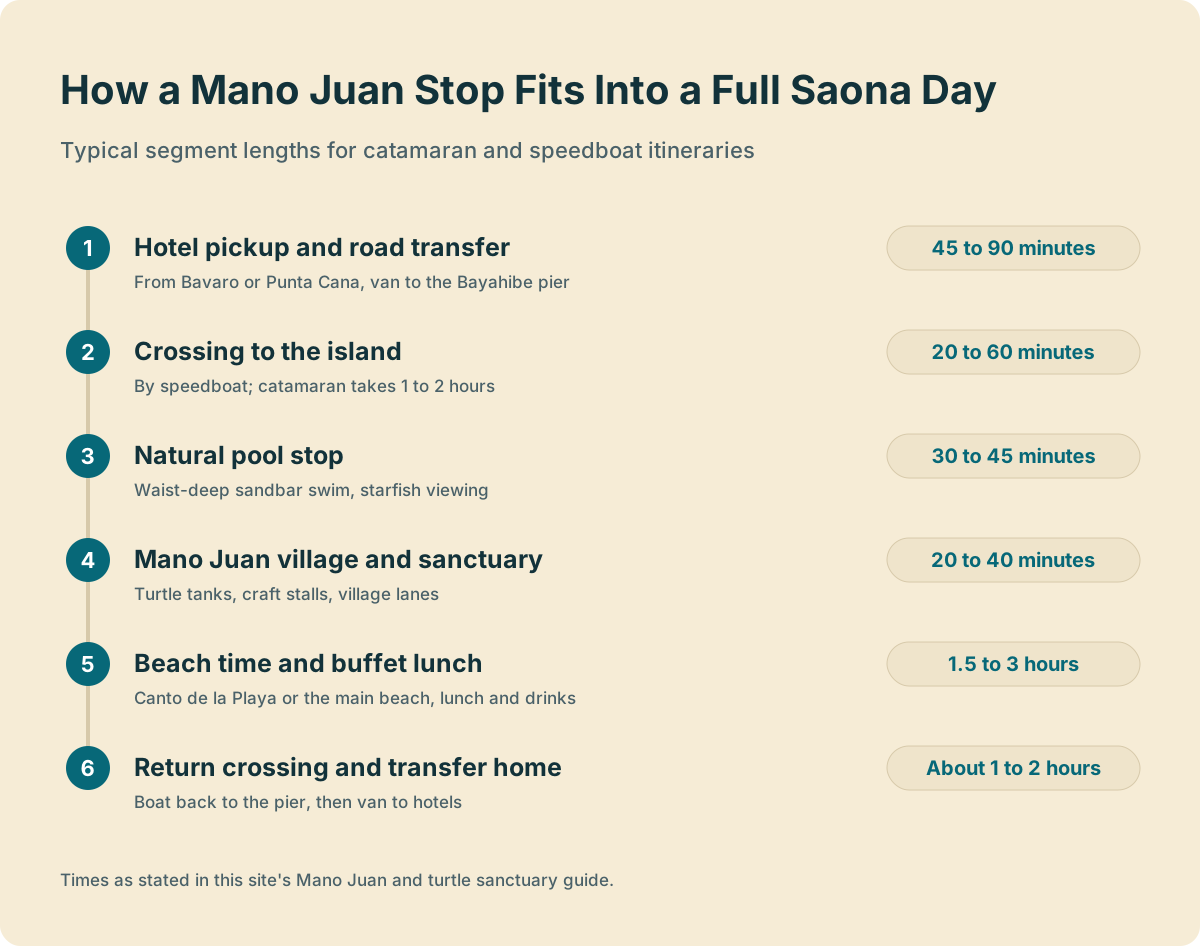
A full Saona day runs about 6 to 12 hours door to door depending on departure point and listing, and the Mano Juan stop usually sits mid-route between the natural pool and the long beach lunch, adding a cultural twenty to forty minutes to an itinerary otherwise spent on water and sand. Every Saona boat leaves from the Bayahibe and Dominicus pier area; Punta Cana and Bavaro guests reach it by road transfer first, with pickups usually starting between 6:30 and 8:00 AM and the drive from the Bavaro hotel zone taking roughly an hour. Crossings are usually 20 to 60 minutes by speedboat and 1 to 2 hours by catamaran, depending on sea and operator, so the village is often the second or third contact with the island in a day. Since the Bayahibe piers sit so close to La Romana itself, many travelers tack on extra time for Altos de Chavon or Catalina, and the guide to filling your La Romana days around a Saona trip explains how those stops fit before or after the boat.
The shape of a multi-stop day, drawn from operator guides and the roster, looks like this:
| Segment | Typical length | What happens |
|---|---|---|
| Hotel pickup and road transfer | 45 to 90 minutes from Bavaro or Punta Cana | Shared or private van to the Bayahibe pier |
| Crossing to the island | 20 to 60 minutes by speedboat, 1 to 2 hours by catamaran | Briefing, life jackets, first views of the park |
| Natural pool stop | 30 to 45 minutes | Waist-deep sandbar swim, starfish viewing |
| Mano Juan village and sanctuary | 20 to 40 minutes | Turtle tanks, craft stalls, village lanes |
| Beach time and buffet lunch | 1.5 to 3 hours | Canto de la Playa or the main beach, lunch and drinks |
| Return crossing and transfer home | About 1 to 2 hours | Catamaran or speedboat back, then van to hotels |
Not every tour includes every stop, and the order shifts with the tide, the crowds and the operator's own sequencing. The only way to know your day's shape is to read the itinerary line by line on the live listing and, where it matters, message the operator. Travelers departing from the capital can also reach the island on a long day out: Santo Domingo departures run from about US$87.90 to 130 per person across the roster, and the Santo Domingo departure guide covers those logistics in full.
The VIP four beaches itinerary above is a good example of the multi-stop shape done at a smaller group size, which matters at the village: a boat of twenty disperses gently down a sandy lane, a boat of sixty does not. Travelers who care about the village stop more than the open bar should weight group size heavily in the decision, a tradeoff explored in detail in the Saona Island small group tour guide.
Do You Pay Extra For The Turtle Sanctuary Stop?
No separate sanctuary ticket exists on the tours that visit it; the village stop is part of the itinerary, while the only standalone cost in the park system is the Cotubanamá entry fee, roughly US$10 to 12 per foreign adult according to independent visitor guides, and many tours bundle even that into the listed price. The Ministry publishes no price list for park entry, so confirm with your operator whether entry is included to avoid paying twice at the wristband booth. On the current roster, 11 of the 40 listings explicitly include national park entrance and the other 29 are silent on it, which makes this the single most useful question to ask before booking any Saona day trip.
Everything else at the village costs what it costs on the day. Craft stall purchases are negotiated, souvenirs are cash, and extras like photos or drinks upgrades are paid on the day for a few dollars, with no reliable published figures. Tipping is not included in tour prices anywhere on the roster; common practice for a full-day tour runs US$10 to 20 per person total for guide and crew, in small bills, though this is a norm rather than a rule. A full cost breakdown lives in how much it costs to go to Saona Island, which walks through per-person, per-group and on-the-day spending.
The four beaches departure above is the value end of the multi-stop family: same south-shore routing that reaches the village, without the VIP framing. Whichever listing you choose, the check is the same. Look for the words Mano Juan in the itinerary, look for park entry in the inclusions, and look at the cancellation terms, which the listing states rather than any third party. Everything else covered here is indexed on Saona Island Dominican Republic Tours.
When Is The Best Time Of Year For The Village And Turtle Stop?
The December to April dry season gives the most reliable village stops, because calmer seas make the shallow approaches to Mano Juan easier, hatchling releases cluster around nesting and hatching periods, and rain interruptions are least likely, while September and October carry the highest rainfall of the year. On 30-year averages the wettest month near the island is September at roughly 175 mm, and the driest are February and March at about 40 mm each. The Atlantic hurricane season runs June 1 to November 30 with peak activity from mid-August to mid-October, and operators may reroute or cancel for rough seas, usually with refunds when they cancel themselves.
Turtle timing is its own layer. Nesting and hatching follow the seasons rather than a published calendar, releases happen when hatchlings are ready, and no operator can promise one on a given day. Treat a release as a possibility, not a feature. What you can count on in the dry season is the stop itself happening, the boats running close to schedule and the water at the village shore being at its clearest. Travelers weighing months against seaweed should also know that sargassum varies by day and Saona's south and west beaches are often clearer than the east coast, though not always: ask the operator about conditions that week, and see the worst months for seaweed in Punta Cana for the seasonal picture.
Crowds follow the weather. Dry season means peak cruise and resort traffic, and the busiest boats fill the village lane quickly. May, June and November sit in the shoulder: fewer people, still-pleasant conditions, slightly higher rain risk. For a full month-by-month breakdown with the tradeoffs spelled out, read the best time to visit Saona Island.
Is The Mano Juan Stop Suitable For Kids And Older Travelers?
Yes, the village stop is one of the most accessible parts of any Saona day: transfers are by boat onto a beach or low jetty, the walking is flat sand lanes, the sanctuary tanks are viewed from ground level, and the pace is set by the guide rather than any physical demand. Compared with the natural pool, which involves stepping off a boat into waist-deep water, or a long beach day in full sun, Mano Juan is the gentle segment. Shade is available under trees and awnings, seating is improvised rather than formal, and the stop is short enough that attention spans hold.
For families, the turtle tanks are the hook. Young children respond to seeing hatchlings up close, and the no-touch, no-remove rules of the park give parents a ready-made lesson in protected-area etiquette. Older travelers and anyone unsteady on their feet should ask the operator about the boarding arrangement at the village, since stepping between a boat and a beach changes with the tide; crew assistance at the stop depends on the tour, so check the listing, but knowing the procedure in advance removes the surprise. Travelers planning a family day out will find the full picture, including stroller and life-jacket considerations, in Saona Island with kids.
One honest caveat: the day around the village stop is long, 6 to 12 hours door to door across the roster, and the road transfer from Punta Cana or Bavaro adds roughly an hour each way before any boat is boarded. Kids and older travelers who enjoy the village often tire at the beach party afterward, so plan the energy budget, not just the itinerary. The packing angle, hats, reef-safe sunscreen, cash and dry clothes, is covered in what to bring and wear to Saona Island.
How Do You Verify A Tour Includes Mano Juan Before Booking?
Read the itinerary text on the operator's live listing for the literal words Mano Juan, confirm park entry appears in the inclusions list, check the departure town matches where you are staying, and message the operator if the wording is vague, because titles and descriptions do not always match. The three listings featured in this guide all name the village or its beaches in their titles, which is the strongest signal available. But rosters change, operators swap stops for sea state, and a listing that says "traditional village visit" without naming Mano Juan may mean a different landing. A thirty-second message to the operator settles it, and reputable listings answer before you pay.
The verification checklist, in the order it pays to run:
| Check | Where to look | Green flag | Red flag |
|---|---|---|---|
| Village named | Itinerary section of the listing | "Mano Juan" written out | Only "beach club" or "island stop" |
| Turtle sanctuary mentioned | Itinerary or highlights | Tanks or sanctuary referenced | No conservation content at all |
| Park entry included | Inclusions and exclusions lists | "National park fees" listed | Nothing said about entry |
| Departure town | Meeting point details | Bayahibe, Punta Cana or your city named | Vague "local operator" wording |
| Group size | Listing details | A stated cap | No size information |
| Cancellation policy | Booking terms | Free cancellation window stated | Strict terms on a weather-dependent trip |
Booking in advance is the norm for multi-stop itineraries, especially in the dry season and now that La Romana's cruise business is expanding: MSC's year-round homeport from November 16, 2026 is projected to add roughly 120,000 visitors a year to the region, and those passengers book Saona excursions from the same pier system. Travelers weighing advance booking against waiting can read the arguments in is it cheaper to book excursions in advance in Punta Cana. The short version for this stop: the tours that include Mano Juan are a subset of the roster, the subset is small, and the good dates fill first.
Common Questions About Mano Juan And The Turtle Sanctuary
Is The Turtle Sanctuary On Saona Island Worth Seeing?
For most travelers, yes. It is small and low-key, but it is the only place on a Saona day trip where you see conservation work inside the park rather than just its beaches, and it pairs naturally with the village walk. If your priority is purely swimming and sun, a single-beach itinerary serves it better.
Do All Saona Island Tours Stop At Mano Juan?
No. Only some itineraries include the village, mainly multi-stop catamaran combos and small group or VIP speedboat trips. Check that the listing names Mano Juan in its itinerary before booking, since classic single-beach group tours usually skip it.
Can You Hold A Turtle At The Saona Sanctuary?
No. The park prohibits touching or removing marine life, and the sanctuary is a working hatchery, not a handling attraction. Visitors view the tanks from the side and, if timing allows, may watch a release from the beach.
How Long Do Tours Spend In Mano Juan Village?
Typically twenty to forty minutes as one stop inside a full day. The length varies by operator and by how the rest of the itinerary is running, so treat any exact figure on a listing as a plan rather than a promise.
Is There An Extra Fee For The Village Or The Sanctuary?
No separate ticket exists on tours that stop there. The only standalone park cost is the Cotubanamá entry fee, roughly US$10 to 12 per foreign adult according to independent guides, and many tours bundle it, so confirm with your operator to avoid paying twice.
Which Departure Point Works Best For A Mano Juan Tour?
Bayahibe is closest to the island, with the pier a few minutes from Dominicus. Punta Cana and Bavaro add roughly an hour of road transfer each way, and Santo Domingo makes for the longest day. All Saona boats depart from the Bayahibe and Dominicus pier area regardless of where your hotel is.