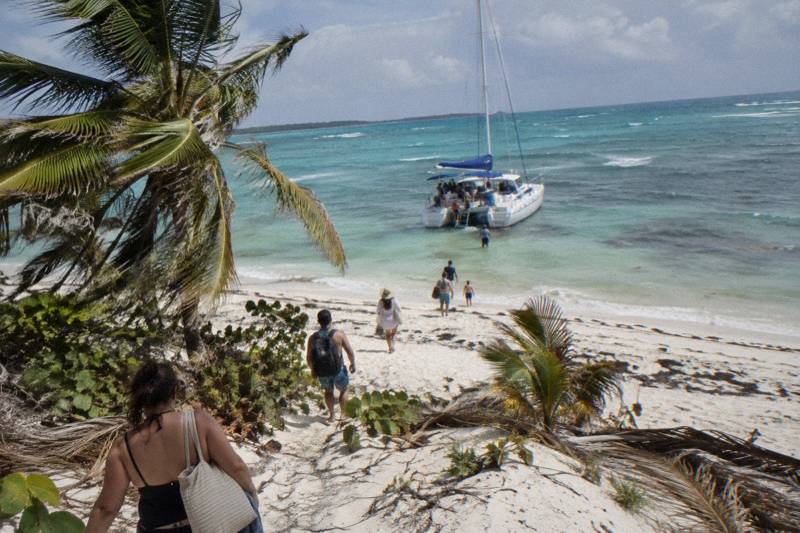
Saona Island Natural Pool And Starfish: What To Expect
The natural pool is the signature stop on nearly every Saona Island trip: a shallow sandbar in the middle of the sea where boats pause so passengers can stand in waist-deep water. Here is what the stop involves, what the starfish rules actually are, and which tours reach it.
Short answer
The Saona Island natural pool is a shallow sandbar off Palmilla where tour boats stop for about 30 to 45 minutes so passengers can wade in clear water and see starfish. Almost all group catamaran and speedboat tours from Bayahibe include it. Touching or lifting starfish is banned, and single-use plastic is prohibited in the park.
What Is The Saona Island Natural Pool?
The Saona Island natural pool is a natural sandbar in open water near Palmilla, on the sheltered side of Saona Island inside Parque Nacional Cotubanamá, where tour boats anchor in waist-deep water so passengers can wade, swim and look for starfish. Most full-day itineraries pause here for roughly 30 to 45 minutes between the boat crossing and beach time, and it is the most photographed stop on the whole excursion. If the scenery looks oddly familiar, our guide to Saona Island and the Pirates of the Caribbean filming rumor separates what the evidence actually supports from the local legend.
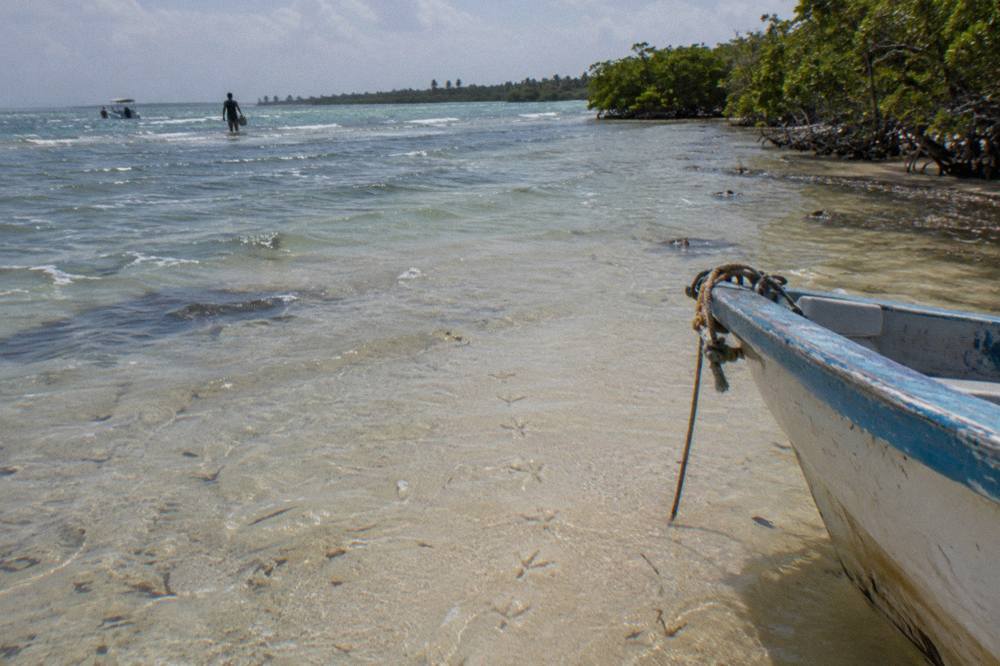
The stop is usually called the Piscina Natural or the Palmilla pool, and it works because a long finger of sand sits just under the surface, well away from any beach. Boats nose up to the bar, cut their engines, and everyone steps down a ladder into water that most adults can stand in. Because the sand is white and the water is only a few feet deep over it, the color at midday is the intense turquoise the island is known for. Operators describe the seabed as sand with scattered patches of seagrass, which is part of why starfish gather here.
Not every tour includes it, and a few include it only in one direction. Mixed itineraries often run speedboat out and catamaran back, and the pool stop commonly sits on the faster leg so the boat can hold position on the bar. When a listing mentions "natural pool", "Piscina Natural" or "Palmilla", that is this stop; when it does not, check the listing before assuming. The Ministry of Environment, which runs the park, publishes no itinerary rules, so the stop is an operator choice rather than a guaranteed part of every ticket. For the broader picture of how the day is built, the Saona Island itinerary guide breaks down each leg in order.
One practical point that surprises first-time visitors: the natural pool is not next to the beach where you eat lunch. It is a separate anchorage reached by boat, usually 20 to 60 minutes away from the Bayahibe pier by speedboat depending on sea and operator. You do not walk to it and you cannot swim to it. If seeing starfish in shallow water is the part of the day you care about most, pick a tour that names the stop explicitly rather than one that only lists "beach time on Saona". If you're weighing whether a different island might suit your day better, our quick guide to Catalina Island compares prices, itineraries, and boat access from La Romana and Bayahibe.
How Deep Is The Water At The Sandbar?
No official depth figure is published for the natural pool by the Ministry of Environment or the park service, so treat any exact meter number you read online with caution. Operator guides consistently describe it as shallow enough that most adults stand with water at waist to chest height, and non-swimmers generally manage the stop because the sandbar is wide and firm underfoot.
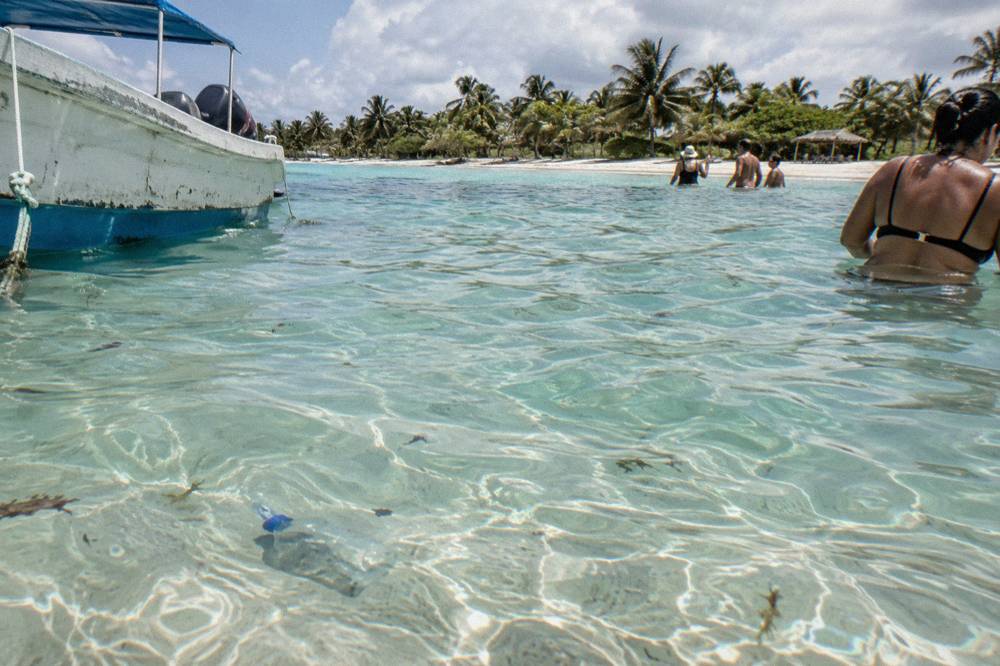
The honest answer is that depth varies with where the boat anchors on the bar and with conditions on the day. The bar itself is broad, and boats deliberately position over the shallowest part so passengers can stand. Toward the edges the bottom drops away, and swimmers who wander off the sand can find themselves out of their depth quickly. Crews typically mark or announce the area passengers should stay inside, and life jackets are usually available on board for anyone who wants one. Confirm jacket availability with your operator rather than assuming.
Tide matters less than you might think, since the Saona section of the coast has only a small tidal range, but wind and swell can change the feel of the stop completely. On a calm dry-season morning the water is glassy and the sand glows through it; on a breezy day the same bar can be choppy enough that crews shorten the stop or move the anchorage. Operators report adjusting landing spots and stop lengths when the sea is rough, and tours can be altered or cancelled outright for weather, with refunds typically available when the operator cancels. That is a condition of the day, not a defect of the tour.
For families, the stop is usually the easiest swimming of the trip because there is no surf and no current to speak of over the bar itself. Toddlers still need constant hands-on supervision, and the ladder entry from the boat is the part that needs the most help. The Saona Island with kids guide covers the age-by-age practicalities, and the general what to bring and wear guide covers the gear that makes the stop better, from water shoes to dry bags.
Which Tours Include The Natural Pool Stop?
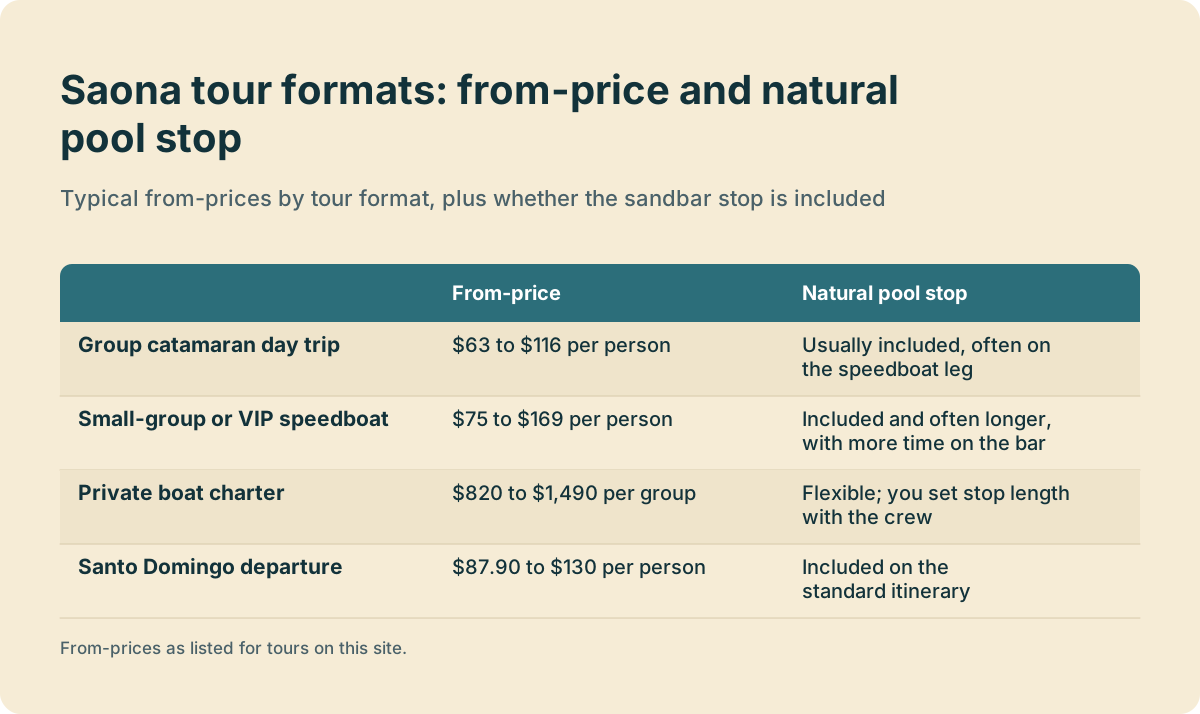
Most full-day Saona tours from Bayahibe, Punta Cana and La Romana include the natural pool as a scheduled stop, typically for 30 to 45 minutes, but inclusion is a listing detail rather than a universal rule: check that the itinerary names the natural pool, Piscina Natural or Palmilla before booking. Group catamaran day trips run from about $63 to $116 per person, and small-group speedboat trips from about $75 to $169. The same itinerary check applies to the village stop, because only some departures actually pause at Mano Juan and its turtle sanctuary, and our guide to which Saona tours include the Mano Juan turtle sanctuary stop explains exactly what that visit involves.
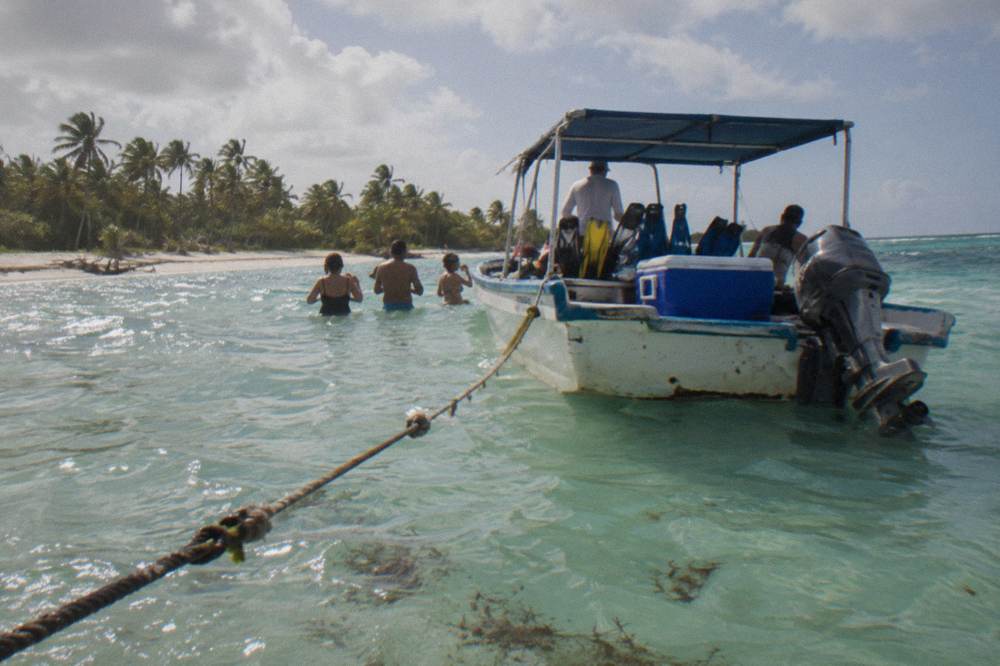
The all-inclusive Saona trip from Punta Cana is the most straightforward pick for readers whose main draw is the sandbar: the listing describes catamaran transport, the natural pool stop, beach time, lunch and an open bar in a single ticket, with hotel pickup listed and free cancellation available. Check availability if that combination fits, and read the full rundown in the Saona Island day trip guide. Two other formats reach the same bar with different trade-offs, summarized below.
| Tour format | Typical from-price | Natural pool stop | Best for |
|---|---|---|---|
| Group catamaran day trip | $63 to $116 per person | Usually included, often on the speedboat leg | First-time visitors, families on a budget |
| Small-group or VIP speedboat | $75 to $169 per person | Included and often longer, with more time on the bar | Snorkelers, photographers, anyone crowd-averse |
| Private boat charter | $820 to $1,490 per group | Flexible; you set stop length with the crew | Celebrations, mixed swimmer abilities |
| Santo Domingo departure | $87.90 to $130 per person | Included on the standard itinerary | Capital-based travelers |
The three options in the band above show the spread. The buffet lunch catamaran day runs the classic Punta Cana route, road to Bayahibe, speedboat to the pool, beach and buffet, catamaran return, from $71.2. The lunch and open bar version stretches the day to nine hours, from $82. Prefer something tighter? The Bayahibe departure skips much of the road time and wraps in six to seven hours from $69. leans into smaller-scale touches and suits readers who would trade some onboard spectacle for a calmer bar stop. Whichever you lean toward, the departure logistics are identical: every Saona boat leaves from the Bayahibe pier area, and Punta Cana and Bavaro guests reach it by about a 60 to 90 minute road transfer, as the how to get to Saona Island guide explains in detail.
One pricing note that trips people up: park entry. The Ministry publishes no price list, so the honest figure is roughly US$10 to 12 per foreign adult according to independent visitor guides, paid by wristband at the site. Only 11 of the 40 Saona tours explicitly list Cotubanamá park entry as included. The rest say nothing, which usually means you pay at the booth or the fee is bundled in without a mention. Ask before you board so you do not pay twice, and carry some pesos or small US bills for the wristband. The full cost breakdown, including tipping norms of roughly US$10 to 20 per person for a full-day crew, sits in the Saona Island price and inclusions guide.
Can You Still See Starfish At Saona Island?
Yes, starfish are still regularly seen at the natural pool and in the seagrass around it, and operators report sightings on most calm days, but they are wild animals whose numbers move with the season, the weather and the crowd level of the day. There is no census and no guarantee; treat starfish as the highlight that usually appears rather than a promise printed on your ticket.
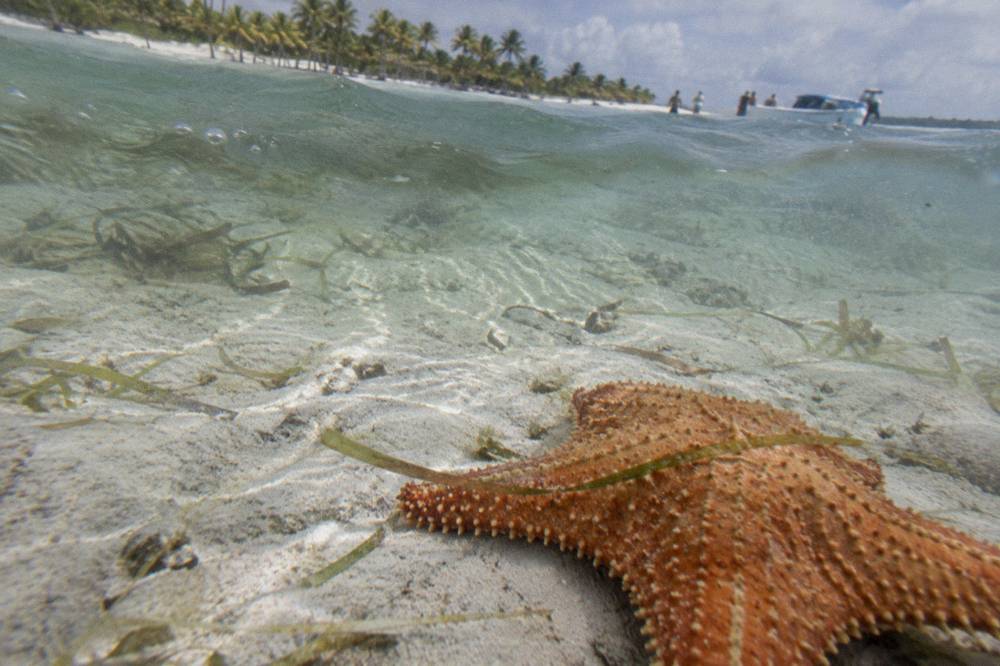
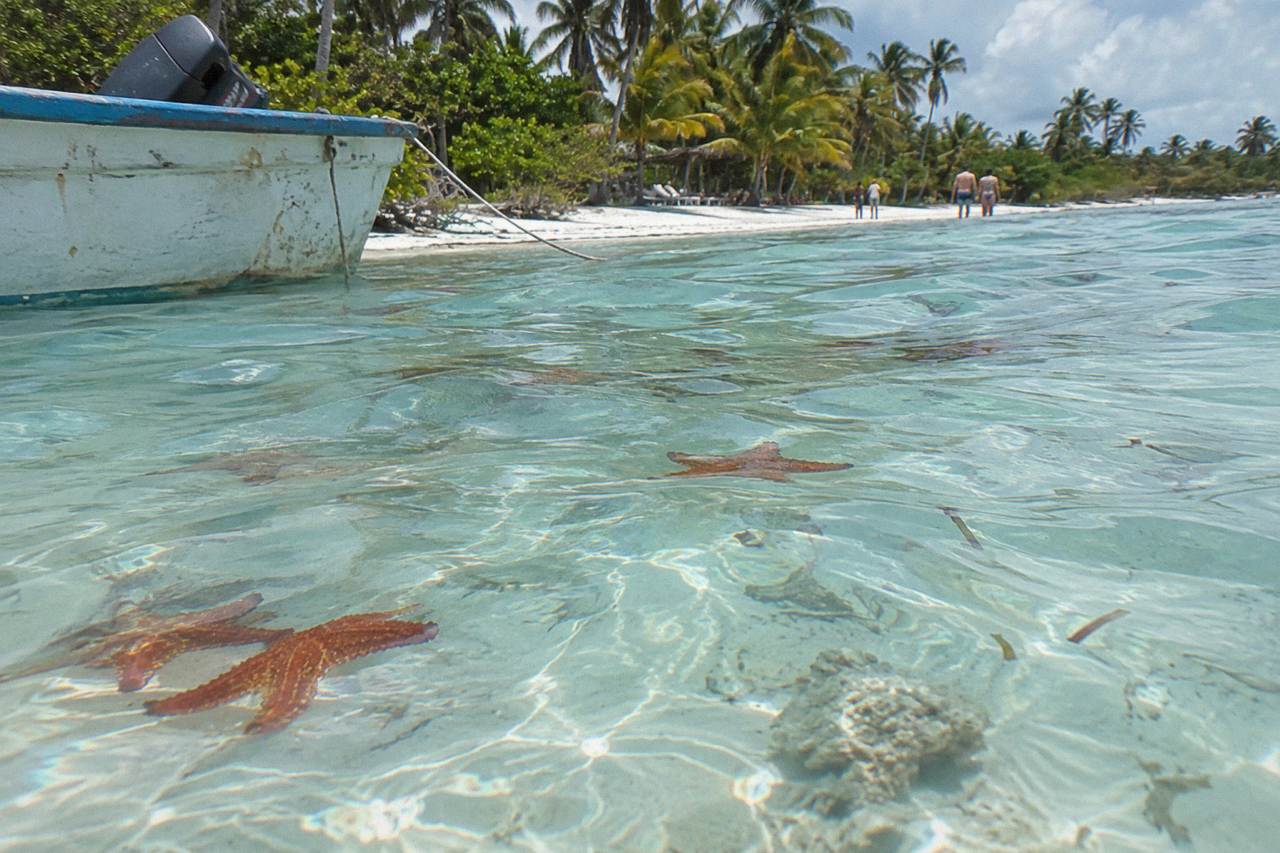
The animals you are looking for are cushion sea stars, the large orange and red stars that sit on the sand and in the turtlegrass patches near the bar. They are the reason the stop became famous: in waist-deep, gin-clear water they are easy to spot from the surface, and on a quiet morning they may be visible from where you stand. Local operators and the community at Mano Juan have pushed back hard against the old tourist habit of lifting them for photos, and the message is now repeated on boats and on signage around the park.
Numbers vary more than the brochures suggest. After several busy days, or when a swell has stirred the shallows, crews report fewer stars in the visited patch. Early departures tend to see more, simply because the bar has had fewer people on it that day; this is an argument for the small-group and VIP speedboat format if starfish are your priority, since those trips carry fewer people onto the bar at once. Sea state matters too, and the same weather that shortens a stop can push stars into deeper grass. Ask your crew on the ride out; they were on the bar yesterday and know.
Sargassum is the wildcard people ask about. 2026 was a heavy sargassum year in the Caribbean overall, but the southeast coast around Saona and Bayahibe saw less impact than the east-facing Punta Cana and Bavaro beaches, because the island deflects much of the weed westward. Monitoring outlooks through late 2026 pointed to declining abundance into the winter. None of that means the water is always clear: it varies by day, and the honest move is to ask the operator about recent conditions at the pool before you book. The Saona Island snorkeling guide covers where visibility is usually best. If sargassum and currents have you wondering about swimming elsewhere on the island, the guide to sea swimming safety in the Dominican Republic explains which bays stay calm and which beaches ask for more caution.
| Factor | Effect on starfish sightings | What you can do |
|---|---|---|
| Calm sea and low swell | Stars sit visible on the open sand | Book dry-season dates when possible |
| Heavy visitation that day | Stars retreat into deeper grass | Choose an early pickup or a small-group trip |
| Sargassum patches in the area | Visibility drops at the surface | Ask the operator about recent conditions |
| Time on the bar | Longer stops reach quieter corners | Pick a VIP or small-group format for more minutes |
What Are The Starfish Rules At Saona?
Do not touch, lift, hold or collect starfish, shells, coral or sand anywhere in Parque Nacional Cotubanamá; the rule comes from the Ministry of Environment under Ley 64-00 and is repeated by every licensed operator. Taking a starfish out of the water, even briefly for a photo, can kill it, and single-use plastic and foam are also banned park-wide under Resolución 0024-2023.
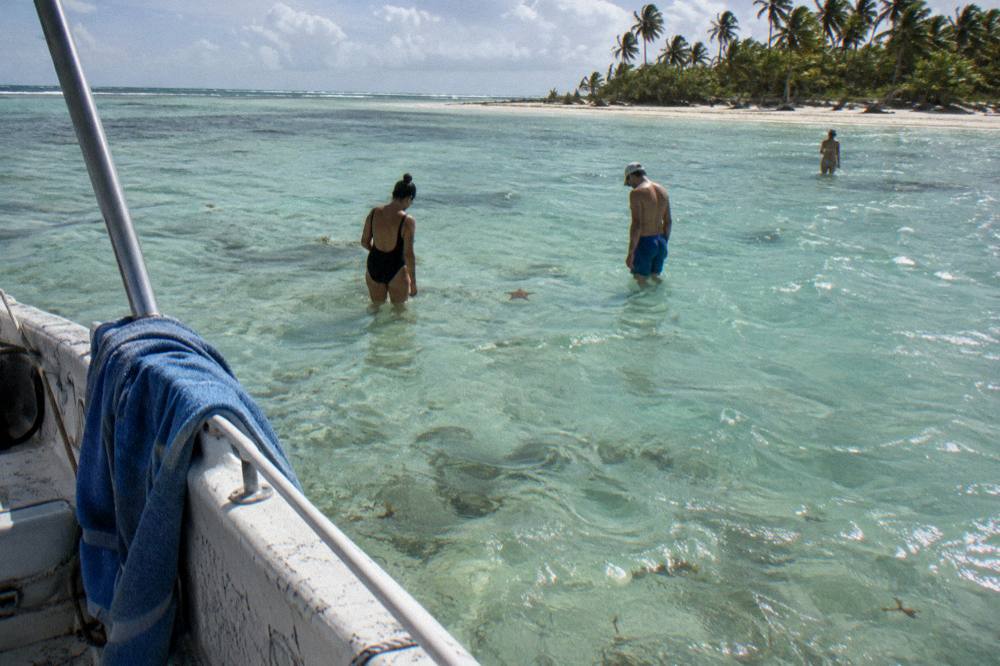
The etiquette is simple once you know it: look, point, photograph from above the water, and leave the animal exactly where it is. Starfish breathe through structures that collapse out of water, and the oils on human skin damage them. The old postcard image of a grinning visitor holding one aloft is now firmly out of bounds, and crews on reputable trips will tell passengers so before anyone gets off the boat. If a crew member offers to hand you a starfish, that is a signal about that operation, not about the rules; the Ministry's own guidance, on its protected-area visitation page at ambiente.gob.do, frames the park as day-use and regulated, with wristband entry and no collection of its wildlife.
The same framework covers the rest of the stop. Reef-safe sunscreen is expected, since ordinary lotion washes off a hundred standing passengers straight onto the bar. Single-use plastic bottles, straws and foam containers are banned in the park, so a refillable bottle is both the rule and the practical choice on a hot sandbar with no shade. And the park is day-use only: there is no wandering off to camp, no overnight stays without a Ministry booking, and no removing anything, down to the sand itself. Travelers coming from the capital can read the Saona Island tour from Santo Domingo guide for the longer-day logistics those rules play out across. If a day trip feels too short, the Saona overnight guide explains the booking rule and the mainland towns that work as a base.
Two practical habits keep you on the right side of all this without thinking. First, keep your feet on sand, not on coral or seagrass heads, both for the habitat and because urchins live in the grass. Second, give starfish distance when you swim: crowding them into a corner of the bar stresses the very animals you came to see. The community at Mano Juan, covered in the turtle sanctuary and Mano Juan guide, depends on the reef staying healthy, and the starfish rule is the visible edge of that whole economy of care.
Is The Natural Pool Stop Safe?
For most visitors the stop is the lowest-risk part of the day: standing depth, no surf, crew supervision and usually life jackets on board. The genuine risks are the edges of the bar, where the bottom drops off, ladders and boat traffic at the anchorage, and rough-sea days when operators shorten or move the stop. Weather cancellations by the operator are normally refunded.
On the boat side, one piece of context belongs here: on 27 July 2026, a tourist boat returning from a Saona excursion suffered an explosion and fire off Bayahibe, injuring 23 people, with no deaths reported, and nothing in the verified reporting ties the incident to any operator on this site. It is a reminder that the transfer legs carry more inherent risk than the sandbar itself, that life jackets matter, and that asking an operator about their safety briefing is a fair pre-booking question. The broader picture, including the current storm-season framing, sits in the is it safe to go on an excursion in Punta Cana right now piece. on how boat tours are run and how to vet an operator before you pay, the guide to excursion safety in Punta Cana and Bayahibe covers that ground.
At the bar itself, the main things to manage are ordinary water-safety ones. Stay inside the area the crew indicates, keep children within arm's reach, and be deliberate on the boarding ladder, which is where most minor slips happen. Boat traffic at the anchorage is managed by the crews, but it is another reason not to swim beyond the marked zone. Alcohol is served on many trips from mid-morning onward; pacing yourself matters more standing in the sun on a sandbar than it does on a shaded catamaran deck. For the full planning picture around season and sea state, see the best time to visit Saona Island guide.
If your priorities line up with a smaller group on the bar, that trip format is worth a look alongside the classic options already covered here on Saona Island Dominican Republic Tours. The site's whole tour types comparison lays out catamaran versus speedboat versus private charter in one table, and the natural pool stop is the single best reason to care about the difference: the same water, the same stars, but a small group standing on it instead of a crowd.
What Should You Know Before You Go?
Bring a refillable water bottle, reef-safe sunscreen, water shoes, cash for extras and tips, and a dry bag for your phone; the park bans single-use plastic and foam, the bar has no shade or facilities, and extras cost a few dollars paid on the day. Confirm park entry, pickup time and the natural pool stop on the listing before you travel.
Entry paperwork is worth one line if you are flying in: most Western nationalities need no visa for stays up to 30 days, the US$10 tourist card is usually included in the airfare, and the free E-Ticket form must be filled in online at eticket.migracion.gob.do before arrival. For the day itself, pickups from Punta Cana and Bavaro hotels usually start between 6:30 and 8:00 AM, the drive to Bayahibe takes about 60 to 90 minutes, and the crossing runs usually 20 to 60 minutes by speedboat and 1 to 2 hours by catamaran depending on sea and operator. Full days run about 6 to 12 hours door to door across the roster, so plan the evening lightly.
| Question to ask the operator | Why it matters for the natural pool |
|---|---|
| Is the natural pool stop named in the itinerary? | Not every tour includes it; some only stop in one direction |
| Is park entry included in the price? | Only 11 of 40 roster listings say so; otherwise budget roughly US$10 to 12 |
| Are life jackets available on board? | Non-swimmers and children should have them at the bar |
| How many passengers share the trip? | Fewer people on the bar means calmer water and more starfish sightings |
| What is the cancellation policy if seas are rough? | Operator weather cancellations are normally refunded |
Common Questions About The Saona Island Natural Pool
What Is The Saona Island Natural Pool?
It is a natural sandbar near Palmilla, inside Parque Nacional Cotubanamá, where tour boats anchor in shallow water so passengers can wade and view starfish. Most full-day tours stop for roughly 30 to 45 minutes.
How Deep Is The Saona Island Natural Pool?
No official depth is published. Operator guides describe it as waist to chest height for most adults over the bar, with deeper water at the edges, and crews indicate where to stay.
Can You Hold Starfish At Saona Island?
No. Touching, lifting or collecting starfish, shells, coral or sand is banned in the park under Ley 64-00 as enforced by the Ministry of Environment. View and photograph them from above the water.
Does Every Saona Tour Stop At The Natural Pool?
Most full-day tours do, but inclusion is a listing detail. Check that the itinerary names the natural pool, Piscina Natural or Palmilla before booking.
Is The Natural Pool Safe For Non-Swimmers?
Usually yes, because the bar is shallow with no surf and life jackets are typically available on board. Stay inside the crew's marked area and be careful on the boat ladder.
How Long Do You Stay At The Natural Pool?
Typically 30 to 45 minutes, depending on the operator, the schedule and the sea state on the day.